USAID
USAID SUSTAINABLE ECOSYSTEMS ADVANCED (USAID SEA) PROJECT
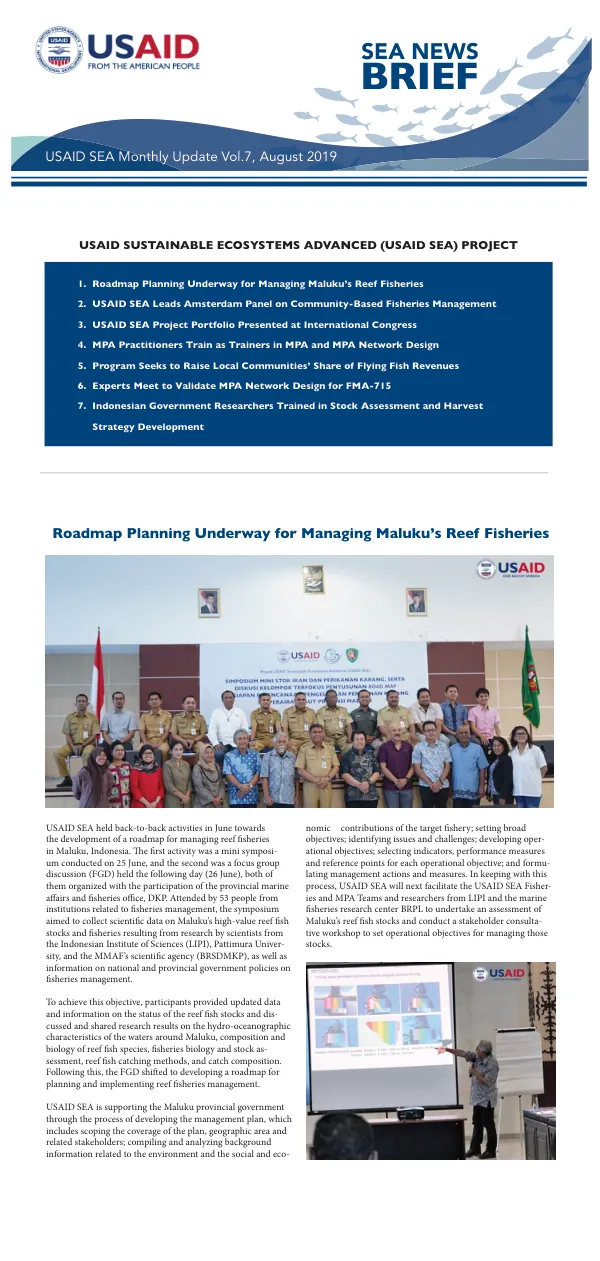
Roadmap Planning Underway for Managing Maluku's Reef Fisheries USAID SEA held back-to-back activities in June to develop a roadmap for managing reef fisheries in Maluku, Indonesia.
2019 · 4 pages
Sign in to readA free account is required to download.
Abstract
A mini symposium on June 25 brought together 53 people from institutions related to fisheries management to collect scientific data on Maluku's high-value reef fish stocks and fisheries. Participants provided updated data on the status of reef fish stocks and discussed research results on hydro-oceanographic characteristics, composition and biology of reef fish species, and fisheries biology and stock assessment. The focus group discussion (FGD) on June 26 shifted to developing a roadmap for planning and implementing reef fisheries management. USAID SEA is supporting the Maluku provincial government in developing the management plan, which includes scoping the coverage of the plan, geographic area, and related stakeholders; compiling and analyzing background information related to the environment and social and economic contributions of the target fishery; setting broad objectives; identifying issues and challenges; developing operational objectives; selecting indicators, performance measures, and reference points for each operational objective; and formulating management actions and measures. A panel of experts led by the USAID SEA Sustainable Fisheries Advisor shared their experience in community-based fisheries management at the Centre for Maritime Research (MARE) Conference in Amsterdam, Netherlands. The discussion focused on lessons learned from community-based fisheries management models that integrate customary and statutory forms of natural resource governance, such as the anchovy fisheries management model being promoted by USAID SEA in the Indonesian province of West Papua. USAID SEA's successes in its field work in Indonesia were presented by two of its implementing partners, the Coral Triangle Center (CTC) and World Wildlife Fund (WWF), at the International Congress for Conservation Biology (ICCB) in Kuala Lumpur, Malaysia. CTC showcased the importance of having local champions to create demand for marine conservation and sustainable fisheries, while WWF presented its activity supporting the Government of West Papua to establish a new marine protected area (MPA) in South Sorong Regency. USAID SEA conducted a training-of-trainers (ToT) workshop on marine protected area (MPA) and MPA network design in Ternate, North Maluku, in support of the Indonesian Government's goal to protect the country's marine resources and achieve sustainable fisheries utilization. The workshop aimed to assist the Ministry of Marine Affairs and Fisheries (MMAF) to design and develop MPAs and MPA networks through policy strengthening and the development of training modules for marine conservation practitioners. In collaboration with the Marine Affairs and Fisheries Faculty of the University of Papua (UNIPA), USAID SEA conducted a flying fish egg processing training workshop for women in Fakfak Regency, West Papua, as part of the project's gender strategy. The workshop aimed to improve gender parity in fisheries, create business opportunities, and increase local community livelihoods. More than 50 women from six Fakfak villages actively participated in the workshop, which came up with a recommendation for the Fakfak Regency Government to introduce regulations allowing local communities to process flying fish eggs before they are transported out of the area. The training workshop on MPA and MPA network design was attended by 24 MPA practitioners with advanced skills in designing MPAs and MPA networks based on biophysical, social, economic, and cultural criteria and guidelines. The participants gained training skills and contributed their recommendations for improving the content and conduct of the workshop, such as adjusting the duration of the sessions to allow for a longer practical session on MARXAN.