USAID
Most Significant Change (MSC) Report: USAID Youth Power
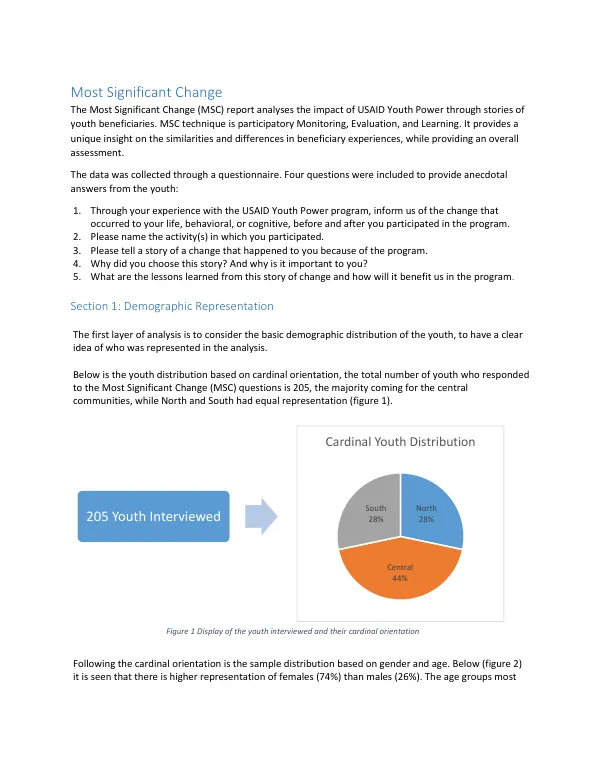
The Most Significant Change (MSC) report analyzes the impact of USAID Youth Power through stories of youth beneficiaries.
2021 · 7 pages
Sign in to readA free account is required to download.
Abstract
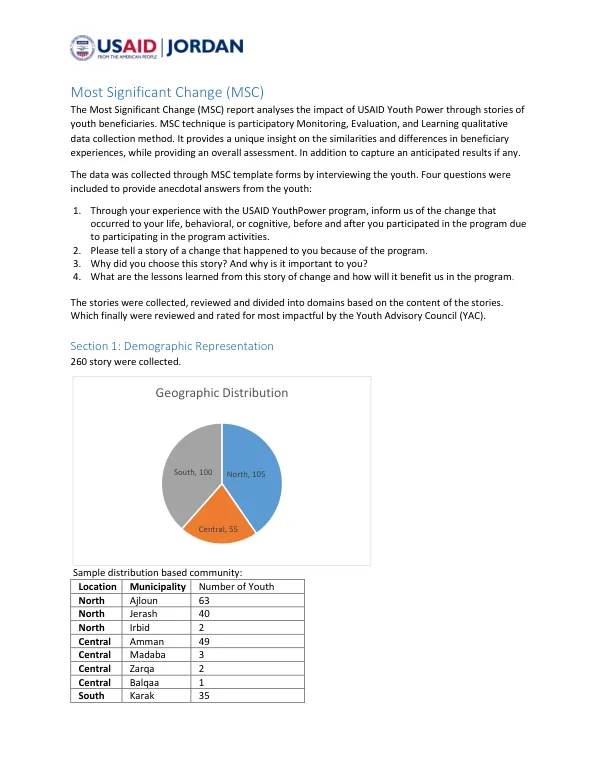
The MSC technique is a participatory Monitoring, Evaluation, and Learning qualitative data collection method that provides a unique insight into the similarities and differences in beneficiary experiences, while also providing an overall assessment. The data was collected through MSC template forms by interviewing the youth, with four questions included to provide anecdotal answers from the youth. The stories were collected, reviewed, and divided into domains based on the content of the stories. The Youth Advisory Council (YAC) reviewed and rated the stories for most impactful. A total of 260 stories were collected, with a sample distribution based on community: North (105), Central (55), and South (100). The sample is predominantly Jordanian females in the age range of 18-24, followed by Jordanian males in the same age range. Eight major initial themes emerged from the cluster analysis: General personality and character change, Improved confidence, Improved overall beneficiary moral and outlook, Improved interpersonal skills, Increase job opportunities or career direction, Improved society and community outlook on beneficiary, Encouraged to finish school or continue studies, and Increased knowledge. When considering the initial answer regarding change through the anecdotal question, the following impacts were indicated: Improved interpersonal skillset, Increased job opportunities/readiness, Improved community outlook of beneficiary, Encouraged to continue education, General increase in knowledge, Greater confidence, General personality & character change, and Greater morale & positive outlook. A secondary analysis further unpacks the narrative provided by the youth, with all the youth who experienced change experiencing that change through one or more of the six domains: Finding their determination, Finding their passion, Becoming supported, Gaining empathy, Becoming more open-minded, and Becoming influential. The Youth Advisory Council (YAC) rated the stories from 1-5 for impact, with an average of 2.8. Seventeen stories were rated with a 5, with examples including a youth who became a trainer and expressed how appreciating and supporting the youth she trained were, a youth who became a facilitator and filled with pride, ambition, and self-confidence, a youth who found her passion through upcycling used cloths, and a youth who gained understanding and empathy through a training on the subject matter. The MSC report provides a comprehensive analysis of the impact of USAID Youth Power on the lives of youth beneficiaries, highlighting the various domains of change and the stories of the youth who experienced these changes. The report demonstrates the effectiveness of the MSC technique in collecting qualitative data and providing a unique insight into the experiences of the youth.
Related documents