USAID FAMINE EARLY WARNING SYSTEMS NETWORK
Mozambique Food Security Outlook Update
The agricultural development initiative in Mozambique has been ongoing since 2010.
2010 · 6 pages
Sign in to readA free account is required to download.
Abstract
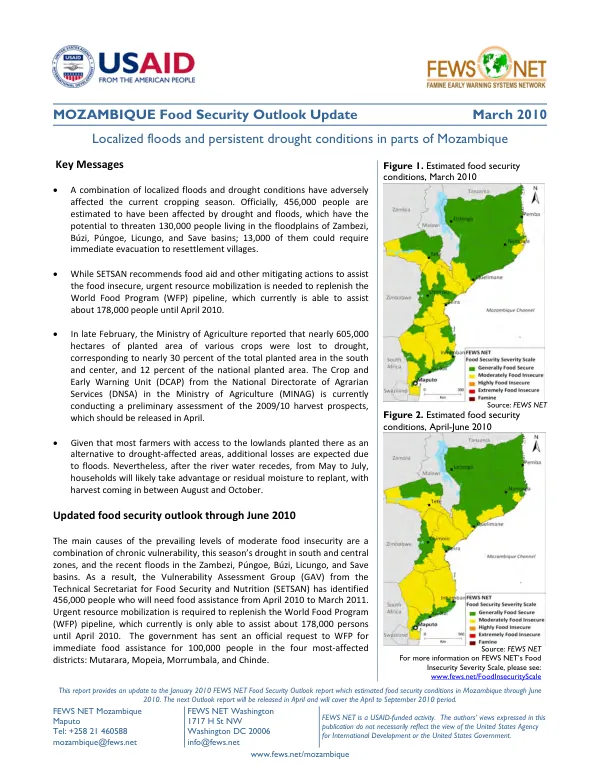
The initiative aims to improve food security and improve the livelihoods of rural communities. The main causes of the prevailing levels of moderate food insecurity are a combination of chronic vulnerability, this year's drought in the central and southern zones, and the recent floods in the Zambezi, Púngue, Búzi, and Save basins. The drought has severely affected the central and southern zones, while the floods have threatened 130,000 people living in the floodplains. The Crop and Early Warning Unit (DCAP) from the Directorate of Agrarian Services (DNSA) is conducting a preliminary assessment of the 2009/10 harvest prospects. The assessment aims to determine the extent of crop losses due to drought and flooding. The floods have resulted in the loss of nearly 605,000 hectares of planted area in the south and central zones, corresponding to nearly 30 percent of the total planted area in these regions. The late-planted crops will require prolonged rains to reach maturity and improve yields. The latest forecast indicates a high probability of below-normal rainfall in much of the country, which is worrisome for decreased water availability. The food security outlook for Mozambique is expected to continue with moderate levels of food insecurity. The recent floods have affected many households, leaving them with limited coping mechanisms. In drought-affected areas, the greatest impact will be felt after June. However, when the floods recede, households will benefit from residual moisture to replant. The initiative has implemented various interventions to improve food security and improve the livelihoods of rural communities. These interventions include farmer training programs, infrastructure development, and market linkage facilitation. The initiative has also established demonstration plots to showcase sustainable agricultural practices. The food prices in Mozambique are expected to become higher than the average for this time of year, especially for maize. The households from the drought and flood-affected areas will have to rely on the market to meet their food needs. The initiative aims to improve the food security and livelihoods of rural communities, but the recent floods and drought have posed significant challenges to achieving this goal. The initiative has also established a system to monitor food prices, which will be increasingly important in the coming months. The system will help to identify areas where food prices are rising and take necessary measures to address the issue. The initiative aims to improve the food security and livelihoods of rural communities, but the recent floods and drought have posed significant challenges to achieving this goal. The initiative has also established a system to monitor the food security outlook, which will help to identify areas where food insecurity is likely to occur. The system will provide early warnings to the relevant authorities, enabling them to take necessary measures to address the issue. The initiative aims to improve the food security and livelihoods of rural communities, but the recent floods and drought have posed significant challenges to achieving this goal. The initiative has also established a system to monitor the crop yields, which will help to identify areas where crop yields are likely to be low. The system will provide early warnings to the relevant authorities, enabling them to take necessary measures to address the issue. The initiative aims to improve the food security and livelihoods of rural communities, but the recent floods and drought have posed significant challenges to achieving this goal. The initiative has also established a system to monitor the water availability, which will help to identify areas where water is scarce. The system will provide early warnings to the relevant authorities, enabling them to take necessary measures to address the issue. The initiative aims to improve the food security and livelihoods of rural communities, but the recent floods and drought have posed significant challenges to achieving this goal. The initiative has also established a system to monitor the food prices, which will help to identify areas where food prices are rising. The system will provide early warnings to the relevant authorities, enabling them to take necessary measures to address the issue. The initiative aims to improve the food security and livelihoods of rural communities, but the recent floods and drought have posed significant challenges to achieving this goal. The initiative has also established a system to monitor the water availability, which will help to identify areas where water is scarce. The system will provide early warnings to the relevant authorities, enabling them to take necessary measures to