USAID DEC
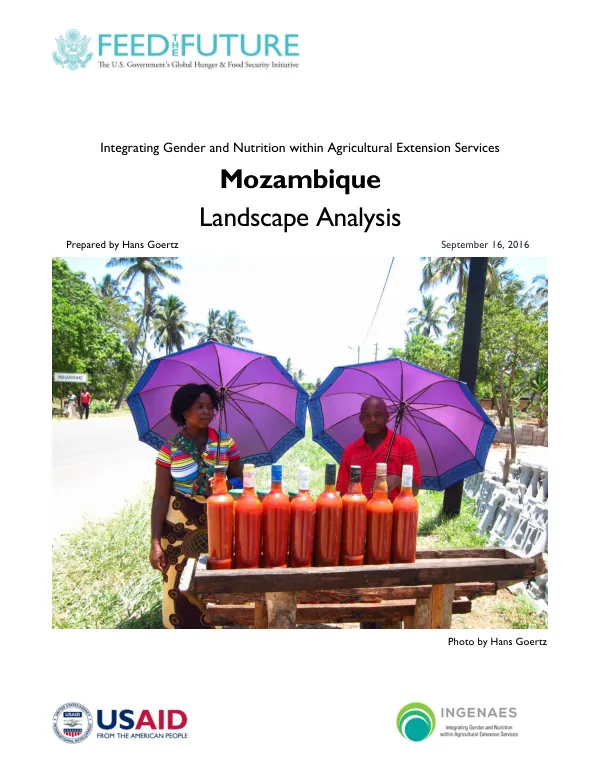
Mozambique Landscape Analysis: Integrating Gender and Nutrition within Agricultural Extension Services
Sign inCULTURAL PRACTICES ORGANIZATION
Mozambique Landscape Analysis: Integrating Gender and Nutrition within Agricultural Extension Services
The agricultural sector in Mozambique is a significant contributor to the country's economy, with the majority of the population relying on agriculture for their livelihoods.
2016 · 31 pages
Sign in to readA free account is required to download.
Abstract
The country's agricultural development is hindered by various challenges, including poverty, nutrition, and gender-related issues. Mozambique has a large rural population, with approximately 70% of the population living in rural areas. The country's population is projected to increase, with a growth rate of 2.3% per annum. Mozambique's agricultural sector is characterized by low productivity, with crop yields averaging 40% below regional benchmarks. The country's agricultural extension services are also limited, with a lack of trained extension agents and inadequate infrastructure. The Mozambique Ministry of Agriculture (MINAG) is responsible for agricultural development, but its capacity to deliver extension services is constrained by limited resources and inadequate institutional frameworks. The country's nutrition situation is also a concern, with high levels of chronic undernutrition affecting approximately 40% of children under the age of five. Mozambique has a National Nutrition Strategy, which aims to reduce chronic undernutrition by 2025. However, the strategy faces challenges, including inadequate funding and limited institutional capacity. The INGENAES project aims to address these challenges by integrating gender and nutrition within agricultural extension services. The project will support the development of improved extension and advisory systems (EAS) to reduce gender gaps in agricultural extension services, increase empowerment of women farmers, and improve gender and nutrition integration within extension services. The project will focus on building more robust, gender-responsive, and nutrition-sensitive institutions, projects, and programs capable of assessing and responding to the needs of both men and women farmers through extension advisory services (EAS). The project will also identify and scale proven mechanisms for delivering improved EAS to women farmers, disseminate technologies that improve women's agricultural productivity and increase household nutrition, and apply effective, nutrition-sensitive, extension approaches and tools for engaging both men and women. Indicative activities of the INGENAES project include learning exchanges, assessments, curricula development, training into action, mentoring relationships, internship experiences, and networks that focus on identifying gender-responsive and nutrition-sensitive innovations that can be promoted by EAS organizations, and adopted by men and women farmers. The project will strengthen the capacity of key stakeholders, including farmers, producer groups, cooperatives, policy makers, technical specialists, development NGO practitioners, and donors. INGENAES will also provide a forum and networks for stakeholders to coordinate and reach agreement on policies and strategies to implement improved EAS that better meet the needs of men and women farmers. The project's ultimate goal is to promote gender equality, improved household nutrition, and increased women's incomes and, subsequently, household food security. Mozambique's agricultural sector is characterized by a lack of access to markets, with many farmers selling their produce at low prices due to limited market information and infrastructure. The country's agricultural extension services are also limited, with a lack of trained extension agents and inadequate infrastructure. The Mozambique Ministry of Agriculture (MINAG) is responsible for agricultural development, but its capacity to deliver extension services is constrained by limited resources and inadequate institutional frameworks. The INGENAES project will focus on building more robust, gender-responsive, and nutrition-sensitive institutions, projects, and programs capable of assessing and responding to the needs of both men and women farmers through extension advisory services (EAS). The project will also identify and scale proven mechanisms for delivering improved EAS to women farmers, disseminate technologies that improve women's agricultural productivity and increase household nutrition, and apply effective, nutrition-sensitive, extension approaches and tools for engaging both men and women.
Related documents