USAID DEC
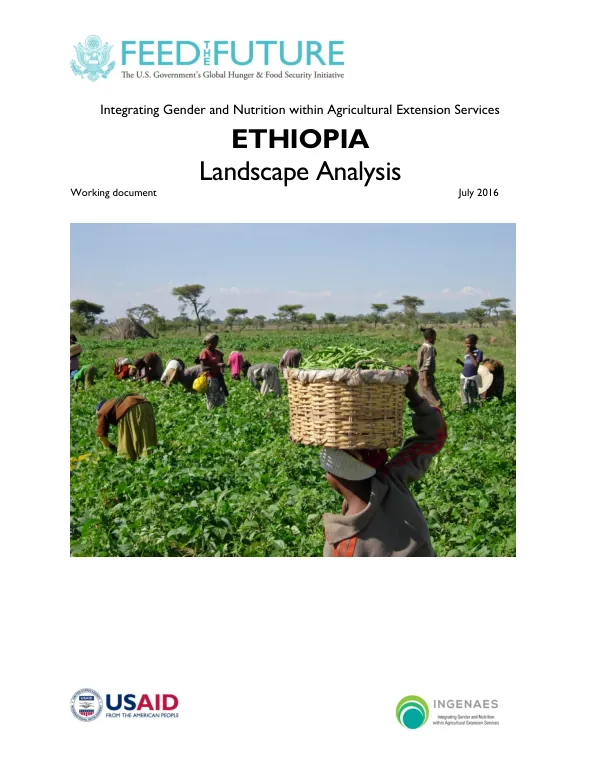
Ethiopia Landscape Analysis: Integrating Gender and Nutrition within Agricultural Extension Services
Sign inFLORIDA INTERNATIONAL UNIVERSITY
Ethiopia Landscape Analysis: Integrating Gender and Nutrition within Agricultural Extension Services
The agricultural sector in Ethiopia is a significant contributor to the country's economy, with the majority of the population relying on agriculture for their livelihoods.
2016 · 28 pages
Sign in to readA free account is required to download.
Abstract
The country's agricultural development is hindered by various challenges, including poverty, limited access to markets, and inadequate extension services. The government of Ethiopia has implemented several initiatives to address these challenges, including the National Agricultural Strategy, which aims to increase agricultural productivity and improve the livelihoods of farmers. The country's agricultural extension services are provided by various institutions, including the Ministry of Agriculture and Natural Resources, the Ethiopian Agricultural Transformation Agency, and non-governmental organizations. However, these services often lack gender sensitivity and fail to address the specific needs of women farmers. The INGENAES project aims to address this gap by strengthening the capacity of extension services to provide gender-responsive and nutrition-sensitive information and activities to farmers. Poverty and human development are significant challenges in Ethiopia, with the country ranking 173rd out of 188 countries in the Human Development Index (HDI). The country's poverty rate is estimated to be around 23%, with the majority of the poor living in rural areas. The government has implemented several initiatives to address poverty, including the Growth and Transformation Plan (GTP), which aims to reduce poverty and improve the livelihoods of the population. Health is another significant challenge in Ethiopia, with the country facing high rates of maternal and child mortality. The country has made significant progress in improving health outcomes, including a decline in child mortality rates from 123 per 1,000 live births in 2000 to 67 per 1,000 live births in 2015. However, the country still faces significant challenges in improving access to healthcare services, particularly in rural areas. The country's agricultural sector is dominated by smallholder farmers, with women making up a significant proportion of these farmers. Women in agriculture face various challenges, including limited access to land, credit, and extension services. The INGENAES project aims to address these challenges by strengthening the capacity of extension services to provide gender-responsive and nutrition-sensitive information and activities to women farmers. The government of Ethiopia has implemented several initiatives to improve the agricultural sector, including the National Agricultural Strategy, which aims to increase agricultural productivity and improve the livelihoods of farmers. The strategy focuses on improving access to markets, increasing the use of irrigation, and promoting the adoption of new technologies. The government has also implemented several programs to improve the livelihoods of farmers, including the Farmer Training Center (FTC) program, which provides training and support to farmers to improve their agricultural productivity. The INGENAES project aims to support the government's efforts to improve the agricultural sector by strengthening the capacity of extension services to provide gender-responsive and nutrition-sensitive information and activities to farmers. The project will focus on building the capacity of extension services to identify and respond to the needs of women farmers, promoting the adoption of new technologies, and improving access to markets. The project will also focus on improving the livelihoods of farmers, particularly women, by providing training and support to improve their agricultural productivity. The project will be implemented in collaboration with various stakeholders, including the government of Ethiopia, non-governmental organizations, and the private sector. The project will also engage with women farmers and other key stakeholders to identify their needs and priorities. The project's activities will be focused on building the capacity of extension services, promoting the adoption of new technologies, and improving access to markets. The INGENAES project will also focus on improving the livelihoods of farmers, particularly women, by providing training and support to improve their agricultural productivity. The project will also promote the adoption of new technologies, including irrigation systems, and improve access to markets. The project's activities will be focused on building the capacity of extension services, promoting the adoption of new technologies, and improving access to markets. The project's impact will be measured through various indicators, including the number of women farmers who have access to extension services, the number of farmers who have adopted new technologies, and the increase in agricultural productivity. The project's success will be evaluated through regular monitoring and evaluation, and the project's activities will be adjusted accordingly.