USAID DEC
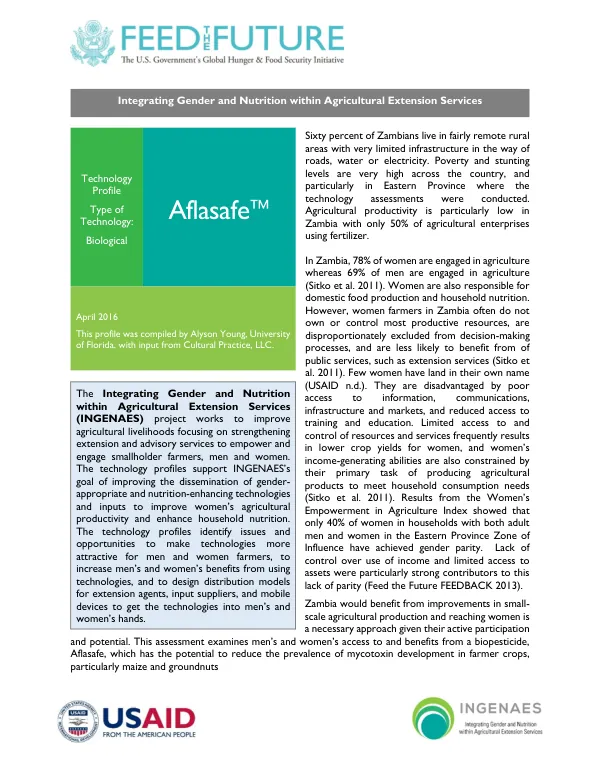
Integrating Gender and Nutrition within Agricultural Extension Services: Technology Profile Aflasafe
Sign inCULTURAL PRACTICES ORGANIZATION
Integrating Gender and Nutrition within Agricultural Extension Services: Technology Profile Aflasafe
Agricultural productivity in Zambia is particularly low, with only 50% of agricultural enterprises using fertilizer.
2016 · 6 pages
Sign in to readA free account is required to download.
Abstract
Sixty percent of Zambians live in rural areas with limited infrastructure, and poverty and stunting levels are high across the country, particularly in Eastern Province. Women are engaged in agriculture, responsible for domestic food production and household nutrition, but often do not own or control productive resources, are excluded from decision-making processes, and have limited access to information, communications, infrastructure, and markets. In Zambia, 78% of women are engaged in agriculture, whereas 69% of men are engaged in agriculture. Women farmers in Zambia often face challenges in accessing resources and services, resulting in lower crop yields and constrained income-generating abilities. The Women's Empowerment in Agriculture Index showed that only 40% of women in households with both adult men and women in the Eastern Province Zone of Influence have achieved gender parity. Lack of control over use of income and limited access to assets were strong contributors to this lack of parity. The Integrating Gender and Nutrition within Agricultural Extension Services (INGENAES) project aims to improve agricultural livelihoods by strengthening extension and advisory services to empower and engage smallholder farmers, men and women. The project works to improve the dissemination of gender-appropriate and nutrition-enhancing technologies and inputs to improve women's agricultural productivity and enhance household nutrition. Aflasafe, a biocontrol method for the management of aflatoxins produced primarily by Aspergillus flavus, has the potential to reduce pre- and post-harvest aflatoxin contamination in crops, particularly maize and groundnuts. Aflasafe involves the introduction of carefully selected atoxigenic strains of A. flavus that outcompete the toxin-producing strains. The technology was first developed by the International Institute of Tropical Agriculture (IITA) in conjunction with the Agriculture Research Service of the U.S. Department of Agriculture, University of Bonn, University of Ibadan, and several other national research partners in Africa. Aflasafe is not yet commercially available in Zambia, but it can only be obtained through field trials. IITA has standardized these field trials so that they are all conducted on crops grown in farmer's fields and individual farmers apply Aflasafe. Field trials were conducted in three districts of Eastern Province, Chipata, Petauke, and Katete, due to the high prevalence of aflatoxin contamination and child undernutrition as well as the infrastructural support available through local development partners. Working with local partners allowed access to well-established networks and infrastructure for distribution of inputs to farmers. Despite the relatively high level of groundnut production, Eastern Province remains one of the poorer areas of the country and has chronically high levels of child undernutrition.