USAID. MISSION TO INDONESIA
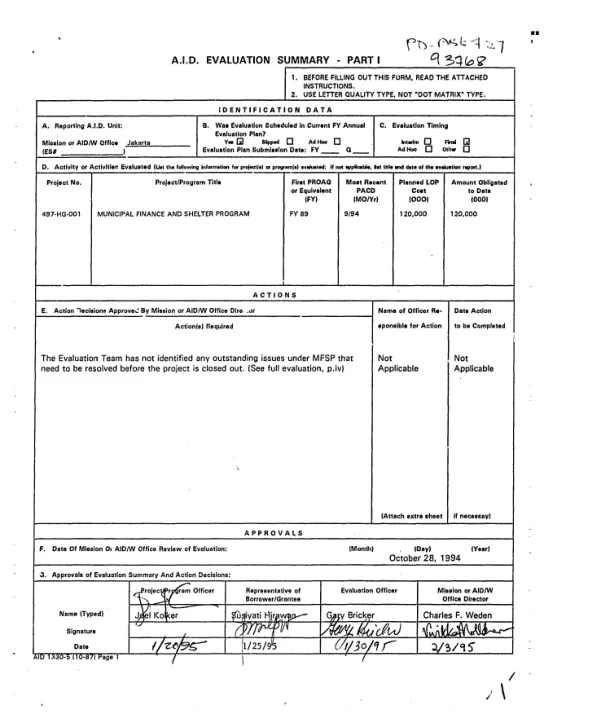
Municipal finance and shelter program
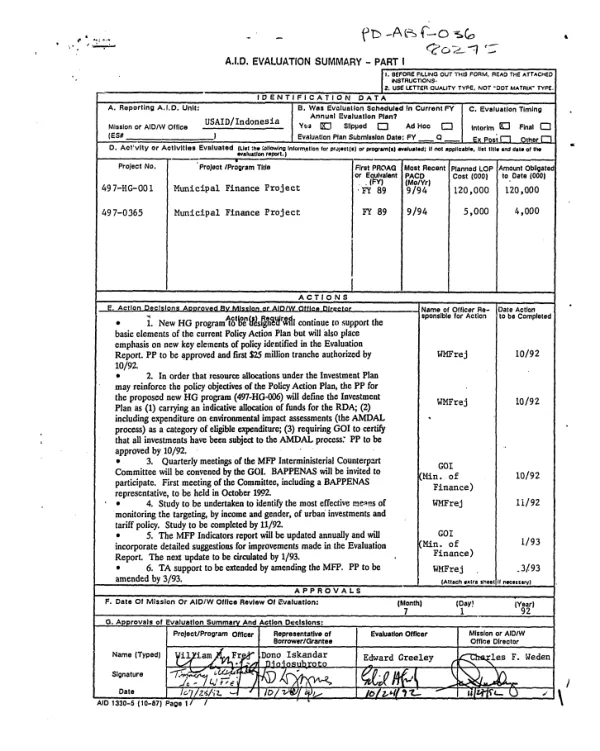
Summarizes final evaluation (PD-ABJ-819) of a housing guaranty (HG) program (1988-94) to assist the Government of Indonesia (GOI) in decentralizing authority and responsibility for urban development to local (municipal) governments.
1995
Sign in to readA free account is required to download.
Abstract
In the early years (1988-92), the GOI had already accomplished a great deal under the program"s Policy Action Plan. It had: (1) transformed the process by which urban infrastructure is programmed through the Integrated Urban Infrastructure Development Program (IUIDP); (2) substantially improved the management of the property tax and other local own-source revenues and enhancement of their yields; (3) established a sound policy and technical base for expanding private sector participation in urban services; (4) built a base for expanded municipal borrowing for urban infrastructure; and (5) maintained a viable framework for interministerial coordination of central government actions affecting urban development. Since 1992, momentum behind the themes of the Policy Action Plan has grown notably and the GOI has done much to address concerns raised in the interim evaluation. Key accomplishments have been in training local personnel in urban and environmental management and planning, and expanding local government revenues and discretion over use of revenues. Other accomplishments include increased community participation in investment programs for infrastructure; transfer of control over nearly all water authorities from the central to the local level; a series of new regulations transferring additional authority for specific functions to local governments; and strong and explicit endorsement of Policy Action Plan themes in the national development plan (Repelita VI). The GOI has documented investments of $188.5 million (vs. a target of $120 million) in local environmental infrastructure in accordance with HG program requirements (i.e., shelter-related improvements benefiting below-median income households not supported by other donors). Also noteworthy are efforts by the GOI and USAID to improve the targeting of program benefits to low-income households, e.g., by narrowing the formula for HG eligibility, and requiring demand surveys as a part of all future local investment planning. Lessons learned were as follows. (1) Concerns are often raised about the ability of broad policy reform projects to deliver clear results. This program succeeded in addressing a broad range of policy issues because program managers recognized the need for clear focus on only a few priorities at a time. They could (and did) shift emphasis in policy dialogues and the allocation of TA as needed to ensure progress in priority areas without losing linkage to the full range of program objectives. (2) Reliable performance monitoring, access to TA resources, and strong RHUDO-Mission collaboration are critical to success in USAID management of urban policy programs. (3) Recognizing and taking advantage of variations in local fund-raising and management capacity may be an important means of expediting results in urban decentralization programs. Addressing infrastructure constraints in cities at the edge of take off will yield much larger benefits to the national economy than focusing on cities that are not yet ready.
Related documents