USAID DEC
My children and I will no longer suffer from malaria: a qualitative study of the acceptance and rejection of indoor residual spraying to prevent malaria in Tanzania
Sign inJOHNS HOPKINS UNIVERSITY BLOOMBERG SCHOOL OF PUBLIC HEALTH/INFO PROJECT
My children and I will no longer suffer from malaria: a qualitative study of the acceptance and rejection of indoor residual spraying to prevent malaria in Tanzania
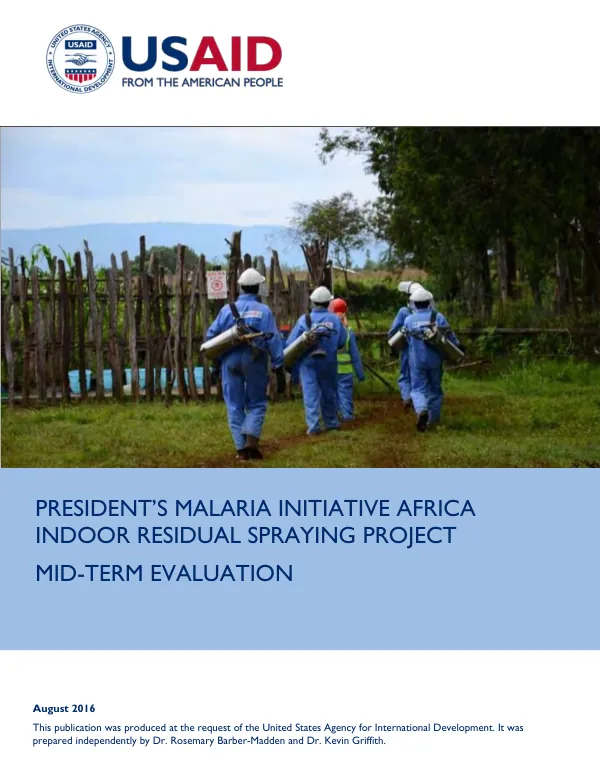
Indoor Residual Spraying (IRS) is a method of controlling malaria on a large scale by spraying the interior of homes with insecticides to kill mosquitoes.
2012 · 17 pages
Sign in to readA free account is required to download.
Abstract
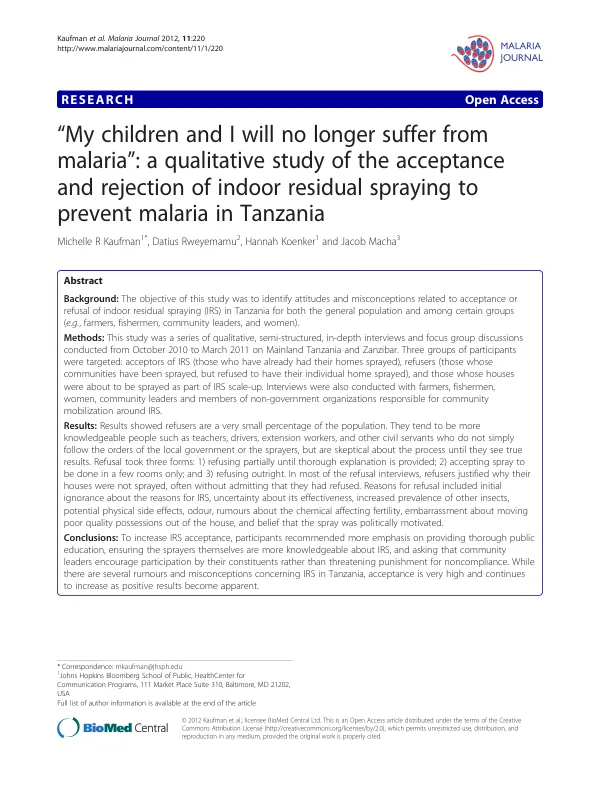
This approach has been used in various parts of the world, including Asia, Europe, Latin America, and Africa, to help eliminate malaria from large areas. In Tanzania, IRS was first used in the late 1950s under the Pare-Taveta project in Northeast Tanzania and in Zanzibar from 1958 to 1968 and from 1981 to 1987. The President's Malaria Initiative (PMI) has funded recent rounds of spraying in Zanzibar starting in 2006 and on the mainland in 2007 in Kagera region, with additional funding for Mara and Mwanza regions in 2010. The non-profit organization RTI International is currently responsible for scaling up IRS in three regions of mainland Tanzania (Kagera, Mwanza, and Mara) with continued spraying in Zanzibar under funding from USAID. This program involves blanket spraying, targeted spraying, and focal spraying, with the main objectives of scaling up IRS on the mainland and maintaining high IRS coverage in Zanzibar, conducting epidemic detection and focal-spraying response, developing an environmental compliance strategy and monitoring plan, and establishing a viable and sustained entomological monitoring system. Malaria is a significant public health problem in Tanzania, with nearly all of the 41 million residents on the mainland and all 1.2 million in Zanzibar at risk of the disease. Estimated annual malaria deaths as of 2008 were 87 per 100,000 for the overall population, and there are 14-18 million episodes of malaria annually in Tanzania, constituting the largest burden of any disease on government resources. Over 40% of all outpatient attendances are attributable to malaria, and the disease is responsible for more than half of all deaths among children under five years of age in health facilities and up to one-fifth of deaths among pregnant women. The financial costs of malaria in Tanzania cannot be accurately estimated, but adults lose one to five days of work per incident depending on the severity and whether or not they are hospitalized, and caretakers lose at least one day of work to care for sick children. Malaria also has adverse effects on school attendance and learning ability for children. In Zanzibar, however, the most recent Tanzania HIV/AIDS and Malaria Indicator Survey showed that malaria prevalence stood at 0.8%, and in 2010, less than 2% of blood smears from patients at the 90 health facility malaria surveillance sites in Zanzibar were positive for malaria parasites. The current utilization of IRS in Tanzania is supported by PMI, which is working to curb malaria incidence on the mainland and sustain the low prevalence in Zanzibar. On the mainland, IRS was launched in 2007 in Muleba and Karagwe districts, located in Kagera Region, and prior to the fieldwork of this study, these districts successfully implemented five rounds of IRS. The study found that refusers of IRS are a very small percentage of the population, and they tend to be more knowledgeable people who are skeptical about the process until they see true results. Reasons for refusal included initial ignorance about the reasons for IRS, uncertainty about its effectiveness, increased prevalence of other insects, potential physical side effects, odour, rumours about the chemical affecting fertility, embarrassment about moving poor quality possessions out of the house, and belief that the spray was politically motivated. To increase IRS acceptance, participants recommended more emphasis on providing thorough public education, ensuring that sprayers themselves are more knowledgeable about IRS, and asking that community leaders encourage participation by their constituents rather than threatening punishment for non-compliance. While there are several rumours and misconceptions concerning IRS in Tanzania, acceptance is very high and continues to increase as positive results become apparent.