USAID DEC
Efficacy, persistence and vector susceptibility to pirimiphos-methyl (Actellic 300CS) insecticide for indoor residual spraying in Zanzibar
Sign inWORLD HEALTH ORGANIZATION
Efficacy, persistence and vector susceptibility to pirimiphos-methyl (Actellic 300CS) insecticide for indoor residual spraying in Zanzibar
The Zanzibar Malaria Elimination Programme (ZAMEP) has implemented indoor residual spraying (IRS) as a principal vector control intervention for malaria control in Zanzibar.
2015 · 7 pages
Sign in to readA free account is required to download.
Abstract
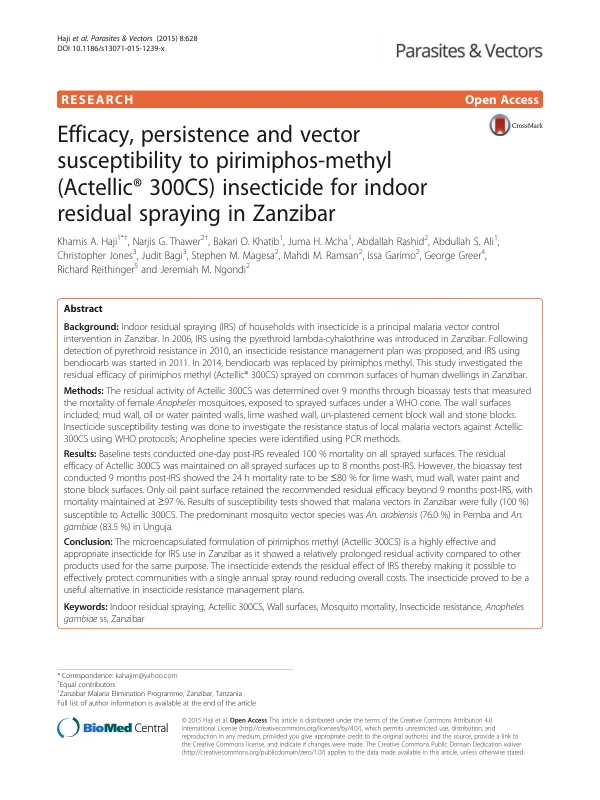
IRS involves applying insecticide to the inside walls and surfaces of houses, which represent resting places for mosquitoes. Mosquitoes are killed upon contact with treated surfaces. The programme has seen a substantial decline in malaria burden in Zanzibar, with malaria prevalence declining from >25% in 2005 to <1% in 2010. In 2006, IRS operations using the pyrethroid lambda-cyhalothrin (ICON 10WP) began in Zanzibar. However, in 2010, pyrethroid resistance against local malaria vectors was detected for the first time in Zanzibar. Following the detection of pyrethroid resistance, an insecticide resistance management plan was developed, and IRS with bendiocarb started in 2012. However, bendiocarb has a short residual life on sprayed surfaces, leading to increased IRS operational costs. In 2014, pirimiphos methyl (Actellic 300CS) was selected for use in Zanzibar due to its longer residual life. Actellic 300CS has been shown to have good residual efficacy for use in IRS operations in various studies. The efficacy and duration of activity of Actellic 300CS were compared to other insecticides used for IRS against malaria vectors in small-scale and large-scale field trials conducted in several countries. Monitoring of insecticides is essential to determine the periods that they remain effective in interrupting malaria transmission and schedule when to re-spray. The effectiveness of an IRS operation is influenced by the residual efficacy of the insecticide used to spray the wall surfaces. According to WHOPES criteria, an insecticide is considered to have adequate residual efficacy if it elicits ≥80% mosquito mortality, 24 h post-exposure on sprayed surfaces. This study investigated the residual efficacy of Actellic 300CS sprayed on common surfaces of human dwellings in Zanzibar, as well as the susceptibility status of local malaria vectors against this insecticide. The study was conducted in two sites in Zanzibar: Kidimni in Unguja and Njuguni in Pemba. A susceptible, laboratory-reared Anopheles gambiae R-70 strain was used for the exposures. Local malaria vector susceptibility status to Actellic 300CS was determined using F1 Anopheles gambiae s.l that had emerged from wild larvae collected from various sites in Unguja and Pemba. The bio-efficacy testing was a longitudinal study aimed at collecting information from selected study sites on a monthly basis for a 9-month period. The susceptibility testing was designed to be a cross-sectional study that collected information at a single point in time. All testing was conducted as per WHO test procedures for insecticide resistance monitoring. Actellic 300CS was sprayed on all test wall surfaces at the recommended dose of one gram of active ingredient/m2 using a Hudson X-pert spray pump. The different surfaces that were sprayed included oil and water painted walls, un-plastered cement block wall, mud plastered wall, lime washed wall, and stone blocked wall. The spraying was done by an experienced spray operator using a Hudson X-pert compression sprayer with a flat nozzle as recommended for IRS by WHO. The residual efficacy of Actellic 300CS was determined over 9 months through bioassay tests that measured the mortality of female Anopheles mosquitoes, exposed to sprayed surfaces under a WHO cone. The wall surfaces included mud wall, oil or water painted walls, lime washed wall, un-plastered cement block wall, and stone blocks. Insecticide susceptibility testing was done to investigate the resistance status of local malaria vectors against Actellic 300CS using WHO protocols; Anopheline species were identified using PCR methods. The baseline tests conducted one-day post-IRS revealed 100% mortality on all sprayed surfaces. The residual efficacy of Actellic 300CS was maintained on all sprayed surfaces up to 8 months post-IRS. However, the bioassay test conducted 9 months post-IRS showed the 24 h mortality rate to be ≤80% for lime wash, mud wall, water paint, and stone block surfaces. Only oil paint surface retained the recommended residual efficacy beyond 9 months post-IRS, with mortality maintained at ≥97%. Results of susceptibility tests showed that malaria vectors in Zanzibar were fully (100%) susceptible to Actellic 300CS. The predominant mosquito vector species was An. arabiensis (76.0%) in Pemba and An. gambiae (83.5%) in Unguja.
Related documents
Documents in this collection
 2012
2012USAID DEC
My children and I will no longer suffer from malaria: a qualitative study of the acceptance and rejection of indoor residual spraying to prevent malaria in Tanzania
Open record 2015
2015USAID DEC