USAID. MISSION TO BELIZE
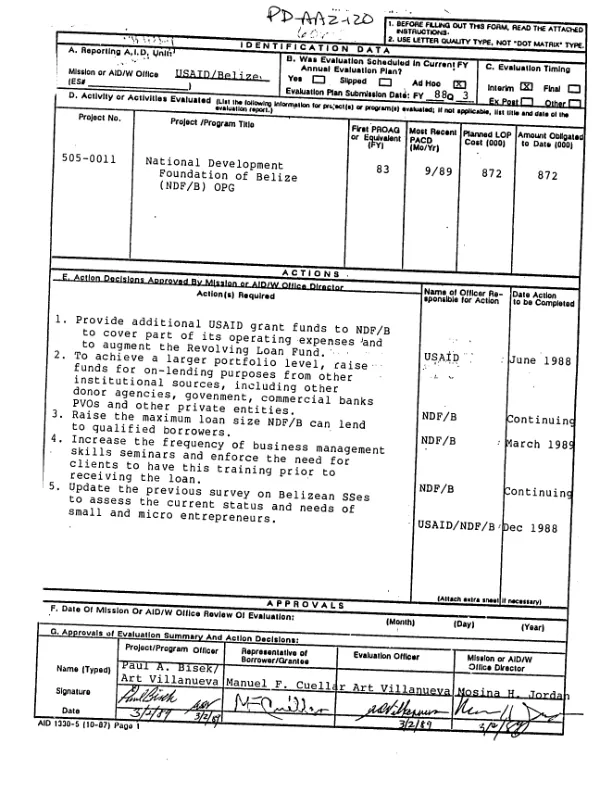
National Development Foundation of Belize (NDF/B) OPG
Summarizes interim evaluation (PD-AAZ-189) of a project to help the National Development Foundation of Belize (NDF/B) provide credit and TA to small-scale enterprises (SSE"s).
1989
Sign in to readA free account is required to download.
Abstract
The evaluation covered the period 8/85-3/88; the impact on SSE"s was measured via a questionnaire administered to a random sample of borrowers. Overall, NDF/B is a strong, well-managed, and effective institution, with strong community support. It has exceeded targets for direct and indirect beneficiaries and number of loans (though the latter has been at the expense of reducing loan size), while falling below targets for numbers of women beneficiaries, jobs protected and created, and new businesses assisted. Progress has been made in meeting 4 of 5 institutional development goals - strengthening and expanding linkages, enhancing management and staff, improving finances, and strengthening the NDF/B Board. The fifth goal, local fundraising, has fallen short by 37.5%, mainly because of the limited number of potential donors. Though now serving a variety of clients, NDF/B"s main focus continues to be small and micro entrepreneurs. Its financial and economic impact on SSE"s has been favorable. Many of the loans have created viable businesses as indicated by profit margins, equity build-up, low arrears levels, and standard of living improvements. NDF/B"s loan processing procedures have been streamlined via improved pre-selection of clients. Collateral arrangements are flexible and are made on a case-by-case basis. NDF/B"s financial situation is healthy, especially when compared to other NDF"s in the region. However, its operating expenses are unrealistically low - mainly because of understaffing - and it will need additional capital funding in order to meet portfolio projections and become self-sufficient by 1990. The Foundation will also have to explore the possibility of other income-generating projects to cover expenses not covered by interest income. On the other hand, it has a great potential for expanding its loan program: loans disbursed through 12/87 totaled only 11% of estimated demand. Several lessons were learned. (1) NDF/B"s provision of business skills training to SSE"s has facilitated a closer relationship with clients and has contributed to the Foundation"s low arrearages rate. (2) Marketing is major constraint facing SSE"s, partly because of their limited ability to promote their products and tap buyers outside the local market. (3) Foreign trade, price, and fiscal policies affect SSE operations insofar as they lead to higher production costs and reduced input supply.
Related documents