USAID DEC
National Responses to Climate Change in Eastern and Southern Caribbean Regional Climate Symposium
Sign inUSAID
National Responses to Climate Change in Eastern and Southern Caribbean Regional Climate Symposium
The Eastern and Southern Caribbean Regional Climate Symposium was organized by the LAC Environment Support Services Contract under contract #GS-00F-193DA Order #7200AA19M00008.
2021 · 45 pages
Sign in to readA free account is required to download.
Abstract
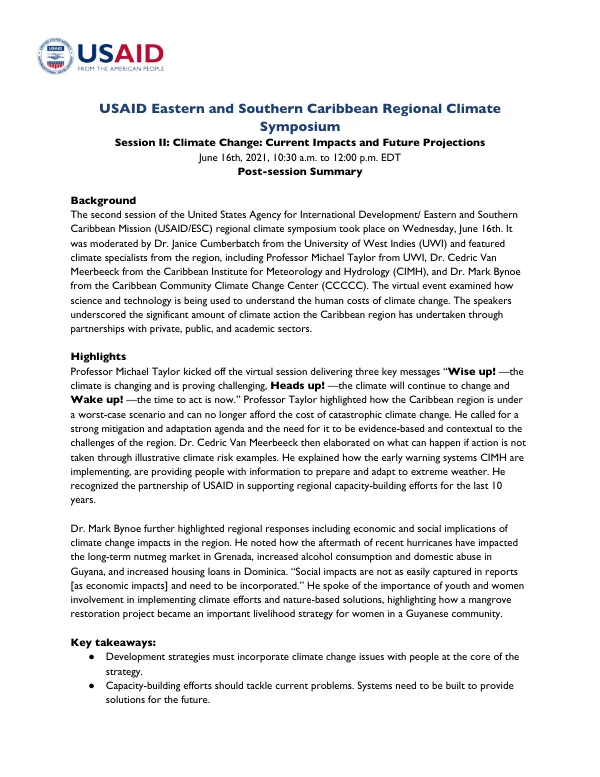
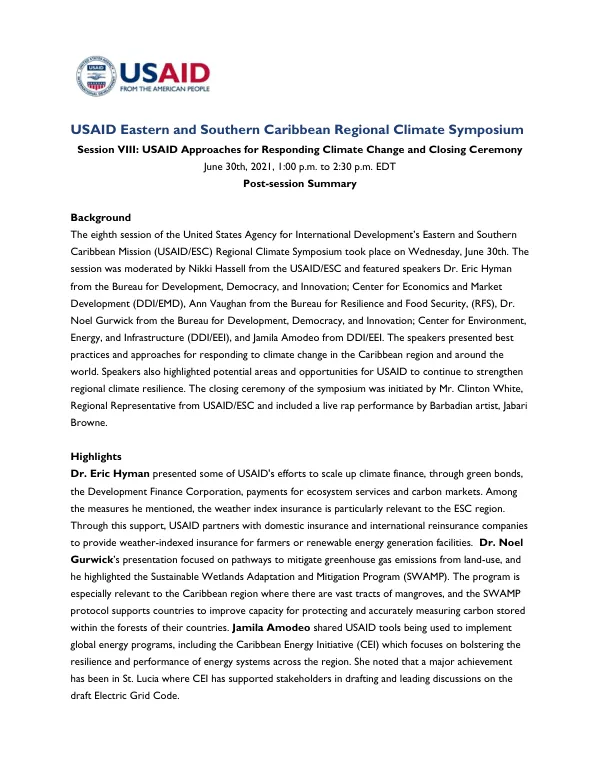
The symposium featured presentations from regional leaders and experts on climate change responses in the Eastern and Southern Caribbean region. Ambassador Karen Lynn Williams of the U.S. Embassy in Suriname delivered the welcome address, highlighting the importance of regional cooperation in addressing climate change. Permanent Secretary Ritesh Sardjoe of the Suriname Ministry of Spatial Planning and Environment presented Suriname's climate action response, emphasizing the need for adaptation and mitigation measures to counter the effects of climate change. Guyana's climate action response was presented by Andrew Bishop, Lead UNFCCC Negotiator for Guyana, Office of the President, Department of Environment and Climate Change. Dr. Hugh Sealy, Special Envoy of the Government of Barbados for Climate Change, presented Barbados' climate action response, focusing on the need for regional resilience and adaptation measures. Dawn Pierre-Nathoniel, Deputy Chief Sustainable Development and Environment Officer, Saint Lucia Department of Sustainable Development, presented Saint Lucia's climate action response, highlighting the importance of sustainable development and environmental protection. Chamberlain Emmanuel, Head, Environmental Sustainability Cluster, Organisation of Eastern Caribbean States Commission, provided a regional perspective on climate resilience, emphasizing the need for coordinated efforts to address climate change impacts. Ritesh Sardjoe, Permanent Secretary for the Environment, Ministry of Spatial Planning and Environment Suriname, presented Suriname's adaptation and mitigation plans, focusing on the need for data generation, climate resilience measures, and low-carbon emission development. The impacts of climate change in Suriname were highlighted, including decreased freshwater availability, saltwater intrusion, increased frequency of flooding and drought, pollution of surface water resources, coastal retreat, damages to coastal infrastructure, and the development of hypersaline conditions in areas along the coast. The focus of Suriname's climate change policy includes generating data and information on Suriname's vulnerability, reducing vulnerability through climate resilience measures, pursuing low-carbon emission development, raising awareness about climate change impacts and opportunities, accessing international climate finance, and integrating climate-compatible development into national development planning. Suriname has developed several national plans to minimize the effects of climate change, including the National Climate Change Policy, Strategy and Action Plan for Suriname 2014-2021, the National Adaptation Plan (NAP) 2019, the Nationally Determined Contribution (NDC) 2020-2030, and the Nationally Appropriate Mitigation Action (NAMA). The NDC seeks to outline a cost-effective pathway to sustainable economic development, building capacity, technology transfer, and finance are critical issues for Suriname in this regard. A carefully prepared portfolio of projects has been developed to support Suriname's climate change response.