USAID DEC
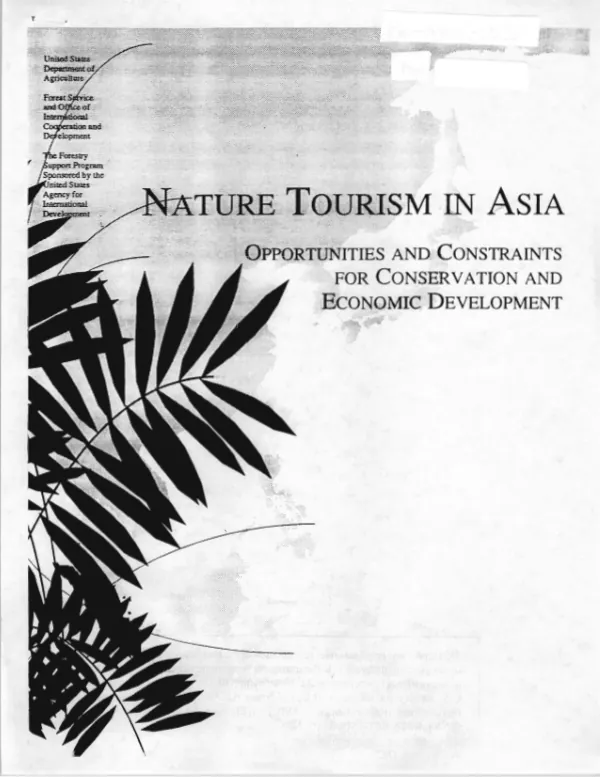
Nature tourism in Asia : opportunities and constraints for conservation and economic development
Sign inU.S. DEPT. OF AGRICULTURE. FOREST SERVICE
Nature tourism in Asia : opportunities and constraints for conservation and economic development
Nature tourism, the fastest growing segment of the tourist industry today, differs from mass tourism in that it seeks to limit ecological damage from tourism activities and increase awareness of ecology, environmental protection, and natural history.
Nenon, Julia; Durst, Patrick B. · 1993
Sign in to readA free account is required to download.
Abstract
This document presents case studies of nature tourism in four Asian countries -- Nepal, Thailand, Indonesia, and Sri Lanka. An introductory study provides a general review of the opportunities and constraints associated with nature tourism development. On the positive side, nature tourism, when pursued intelligently and with foresight, has the potential to generate economic benefits while contributing to environmental conservation. On the negative side, nature tourism poses numerous risks in regard to environmental degradation, economic leakages, low earnings capacity, and uncertain social impacts. Weighing these pro"s and con"s requires an objective assessment in a given concrete setting. To be successful, nature tourism must reconcile the interests of the various stakeholders involved -- the tourists themselves, local landowners and users, government agencies, tour operators, investors and concessionaires, and NGOs. A public-private coordinating council dialogue devoted to this purpose has been found helpful in some cases. Donors like USAID can support the development of nature tourism in several ways: by carefully weighing the benefits and costs of various development scenarios; by formulating an overall nature tourism strategy; and by assisting specific projects in the areas of infrastructure, training, marketing and promotion, and fiscal, reserves, and general tourism management.