USAID DEC
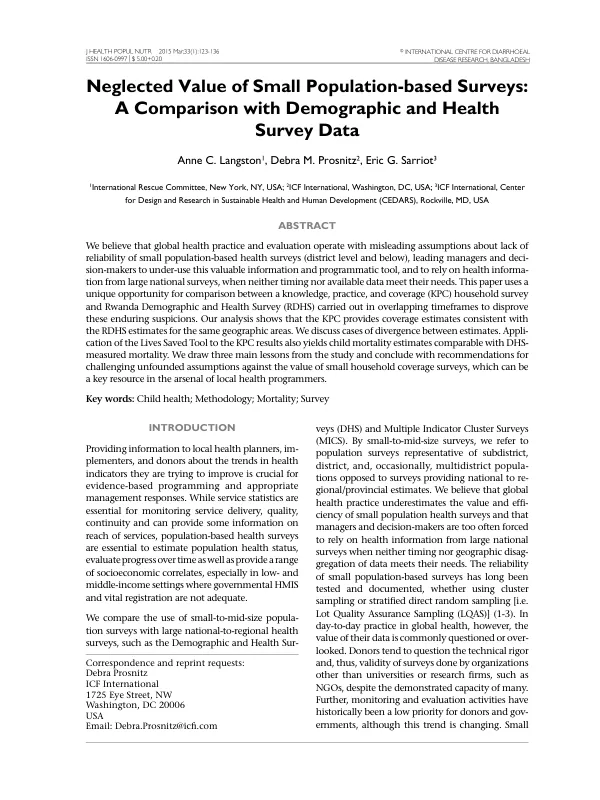
Neglected Value of Small Population-based Surveys: A Comparison with Demographic and Health Survey Data
Sign inICF
Neglected Value of Small Population-based Surveys: A Comparison with Demographic and Health Survey Data
The International Centre for Diarrheal Disease Research, Bangladesh published a study in the Journal of Health, Population and Nutrition in 2015.
2015 · 14 pages
Sign in to readA free account is required to download.
Abstract
The study aimed to compare the use of small-to-mid-size population surveys with large national-to-regional health surveys. The authors argue that global health practice underestimates the value and efficiency of small population health surveys. Small population surveys are often overlooked due to concerns about their technical rigor and validity. However, the authors argue that these surveys have been tested and documented to be reliable. They propose that small population surveys can be used to capture baseline data and measure progress specific to their project area. The study used a knowledge, practice, and coverage (KPC) survey and data from Rwanda's Demographic and Health Survey (RDHS) to compare the estimates of health indicators. The results showed that the KPC survey provided coverage estimates consistent with the RDHS estimates for the same geographic areas. The authors also applied the Lives Saved Tool to the KPC results, which yielded child mortality estimates comparable with DHS-measured mortality. The study highlights the importance of small population surveys in providing information to local health planners, implementers, and donors. The authors argue that these surveys can be used to inform district managers on population health status and intervention coverage. They also propose that small population surveys can be used to capture baseline data and measure progress specific to their project area. The KPC survey is an example of a small population survey method used in estimating levels of and changes in many standard maternal and child health indicators. The KPC tool consists of seven modules aligned with technical areas, from which implementing organizations can choose. It is implemented using either a cluster or stratified sample design. The study concludes that small population surveys can be a valuable resource in the arsenal of local health programmers. The authors recommend challenging unfounded assumptions against the value of small household coverage surveys and propose that these surveys can be used to inform district managers on population health status and intervention coverage.