USAID DEC
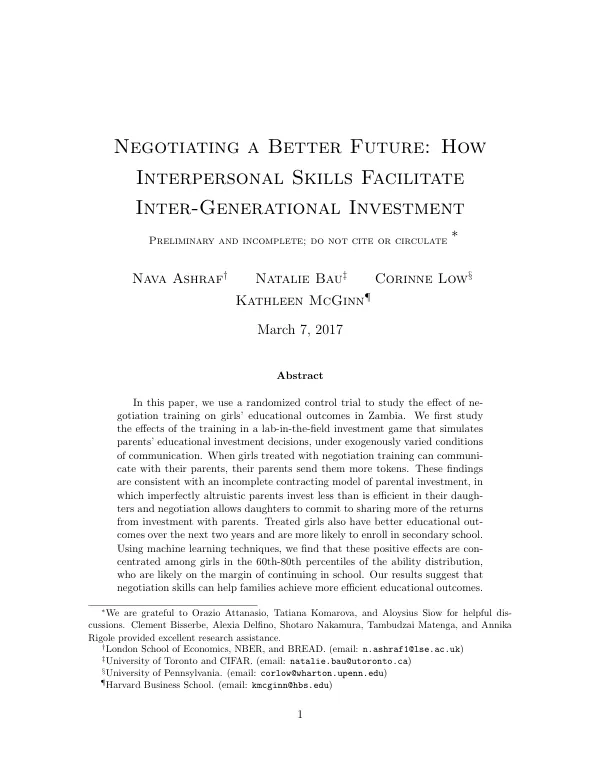
Negotiating a Better Future: How Interpersonal Skills Facilitate Inter-Generational Investment
Sign inUNIVERSITY OF PENNSYLVANIA
Negotiating a Better Future: How Interpersonal Skills Facilitate Inter-Generational Investment
The study of interpersonal skills and their impact on inter-generational investment is a critical area of research.
2017 · 60 pages
Sign in to readA free account is required to download.
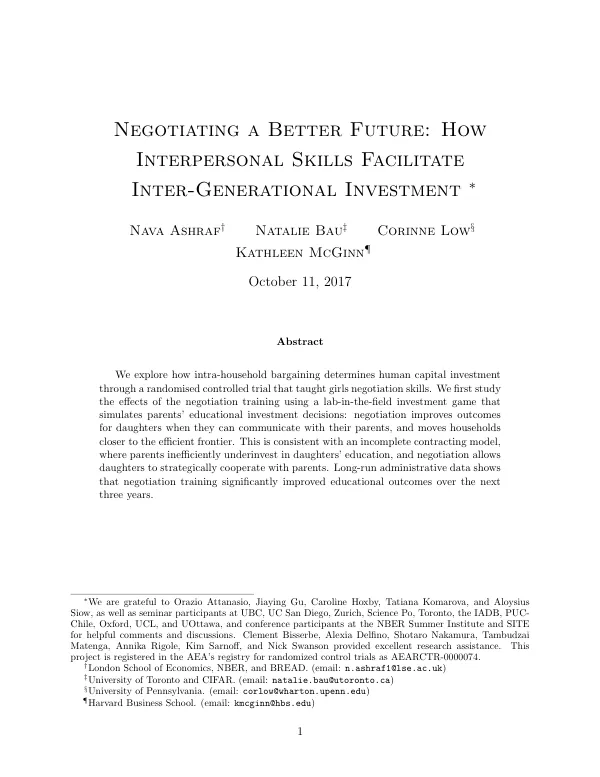
Abstract
Intra-household bargaining plays a significant role in determining human capital investment, particularly in vulnerable environments. A randomized controlled trial was conducted to teach adolescent girls in Zambia negotiation skills, with the aim of improving their educational outcomes. The negotiation training emphasized identifying one's own and one's negotiating partner's deeper interests and using this information to brainstorm solutions that benefited both parties. This approach was more closely aligned with increasing strategic cooperation across many interactions than increasing a girl's bargaining power in one-shot negotiations. The safe space program, on the other hand, provided a physical space for girls to gather with a role model, following common female empowerment treatments throughout the world. To measure the impact of negotiation skills on girls' outcomes, multiple years of administrative education data, household surveys, and an incentivized investment game between parents and children were used. The lab-in-the-field experiment simulated educational investment decisions to better understand the mechanisms through which negotiation affected girls' educational outcomes. The results showed that negotiation skills played a significant role in resolving incomplete contracting problems in the household, fostering strategic cooperation between parents and children. The negotiation treatment had a positive impact on girls' long-run human capital, with improved administrative measures of educational outcomes. In contrast, the safe space treatment had no significant differences in long-run outcomes compared to the control group. The negotiation treatment had larger positive effects for a more advantaged sub-sample of girls, with statistically significant larger effects than the safe space treatment. The study highlights the importance of negotiation skills in improving educational outcomes for girls in vulnerable environments. The findings suggest that negotiation can play a critical role in resolving incomplete contracting problems in the household, fostering strategic cooperation between parents and children. The results also indicate that negotiation has a positive impact on girls' long-run human capital, particularly for more advantaged sub-samples. The study's methodology involved a three-arm intervention consisting of a negotiation program, a safe space program, and a control group. The negotiation curriculum emphasized identifying one's own and one's negotiating partner's deeper interests and using this information to brainstorm solutions that benefited both parties. The safe space program provided a physical space for girls to gather with a role model, following common female empowerment treatments throughout the world. The study's findings have important implications for policymakers and practitioners working to improve educational outcomes for girls in vulnerable environments. The results suggest that negotiation skills can play a critical role in resolving incomplete contracting problems in the household, fostering strategic cooperation between parents and children. The study's methodology provides a useful framework for future research on the impact of negotiation skills on educational outcomes. The study's results also highlight the importance of considering the role of negotiation skills in improving educational outcomes for girls in vulnerable environments. The findings suggest that negotiation can have a positive impact on girls' long-run human capital, particularly for more advantaged sub-samples. The study's methodology provides a useful framework for future research on the impact of negotiation skills on educational outcomes.