USAID DEC
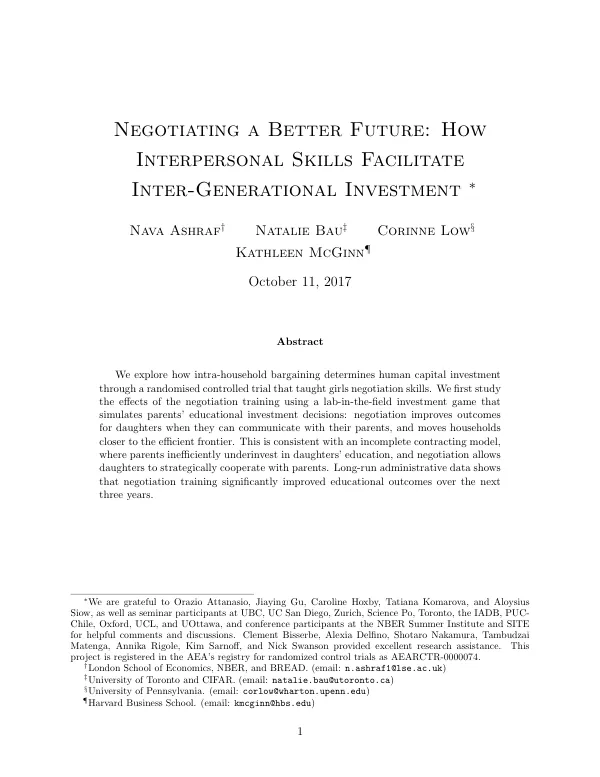
Negotiating a Better Future: Interpersonal Skills Facilitate Inter-Generational Investment
Sign inUNIVERSITY OF PENNSYLVANIA
Negotiating a Better Future: Interpersonal Skills Facilitate Inter-Generational Investment
In a study conducted in Zambia, researchers investigated the impact of negotiation training on girls' educational outcomes.
2017 · 61 pages
Sign in to readA free account is required to download.
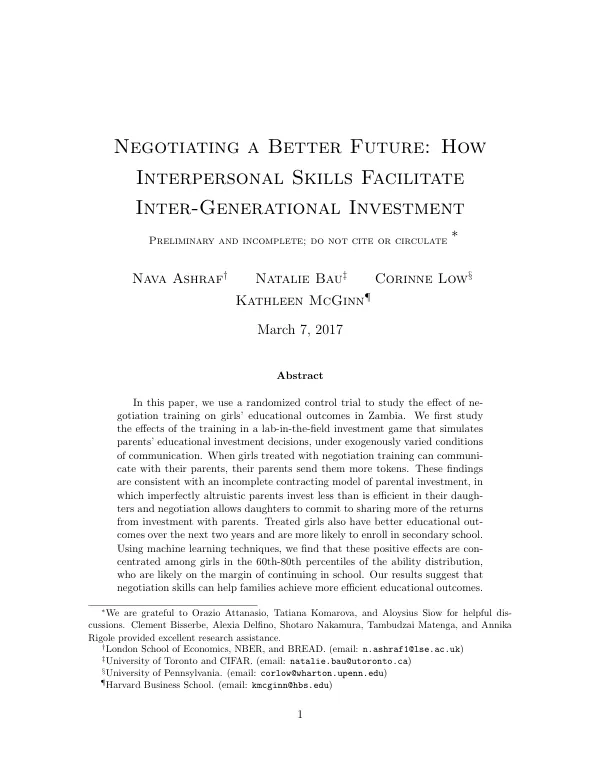
Abstract
The study used a randomized control trial to examine the effects of negotiation training on parents' educational investment decisions. The researchers found that girls who received negotiation training were able to communicate more effectively with their parents, resulting in increased investment in their education. The study involved a lab-in-the-field investment game, where parents were given tokens that could be converted into cell phone airtime. The tokens sent to their daughters were doubled, and daughters received a randomly chosen income shock of 2 or 4 tokens. The daughters then decided how many tokens to return to their parents and how many to redeem for prizes. The results showed that parents who received negotiation training sent their daughters more tokens, indicating increased investment in their education. The study also collected administrative data on girls' educational outcomes, including their school enrollment and attendance rates, average scores on the national exam, and whether they became pregnant in the post-treatment period. The results showed that girls who received negotiation training had measurably higher human capital in the long run, with stronger and more precise effects among the sub-sample of girls who attended the lab-in-the-field experiment. The researchers found that negotiation skills can play a role in resolving incomplete contracting problems between parents and children. The study suggests that improving children's negotiation and interpersonal skills can allow them to increase their human capital investment by persuading their families to invest more in their education. The findings have implications for policy interventions aimed at improving educational outcomes in low-income countries.
Related documents