USAID DEC
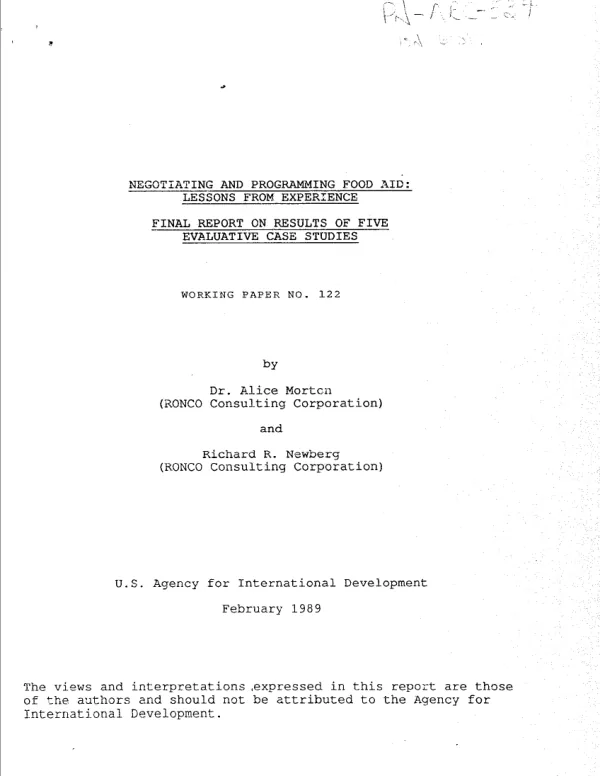
Negotiating and programming food aid : lessons from experience -- final report on results of five evaluative case studies
Sign inUSAID. BUR. FOR FOOD FOR PEACE AND VOLUNTARY ASSISTANCE
Negotiating and programming food aid : lessons from experience -- final report on results of five evaluative case studies
Case studies were conducted of apparently successful P.L.
Morton, Alice; Newberg, Richard R. · 1989
Sign in to readA free account is required to download.
Abstract
480 - especially Title I - programs in Zambia, Haiti, Pakistan, Tunisia, and Mali to examine (a) the process of identifying and implementing self-help provisions and (b) the programming of local currency proceeds. Major findings were as follows. Self-help provisions (1) As the programs in Haiti and Pakistan indicate, experienced A.I.D. foreign service nationals should play a major role in monitoring and evaluating self-help provisions, with short-term help, where needed, from U.S. or host government staff or from consultants. (2) P.L. 480 self-help measures should be integrated as far as possible with the policy implications of other Mission projects in order to facilitate policy reform at the sectoral level. (3) Other donors must encourage the host government to achieve self-help objectives, as in the case of the Mali multi-donor cereals program. (4) Host country officials should be given whatever help they need to report accurately on self-help provisions. Such reporting should be timed to fit the schedule of the host, not the U.S., government. Local currency proceeds (1) Large amounts of local currency proceeds can cause programming problems, especially for the host government. In such cases, management of the proceeds should be kept as simple as possible, as in the case of Pakistan. (2) Reporting requirements should be adapted to host government accounting and budgeting procedures. (3) Special accounts should not be required on the assumption that they will facilitate greater accountability. (4) Early joint programming of funds is preferable to post-negotiation programming. (5) Management difficulties often make the use of local currency proceeds to meet the 25% host government counterpart requirement impractical, as in Haiti. (6) More creative use should be made of local currency proceeds to support other donor efforts that reinforce A.I.D. policy reform goals. (7) USAID"s should make greater use of local currency proceeds to help finance the implementation of self-help measures. The report also includes lessons for policy dialogue and recommendations for improving the P.L. 480 program. Executive summaries of the case studies are appended.
Related documents