USAID DEC
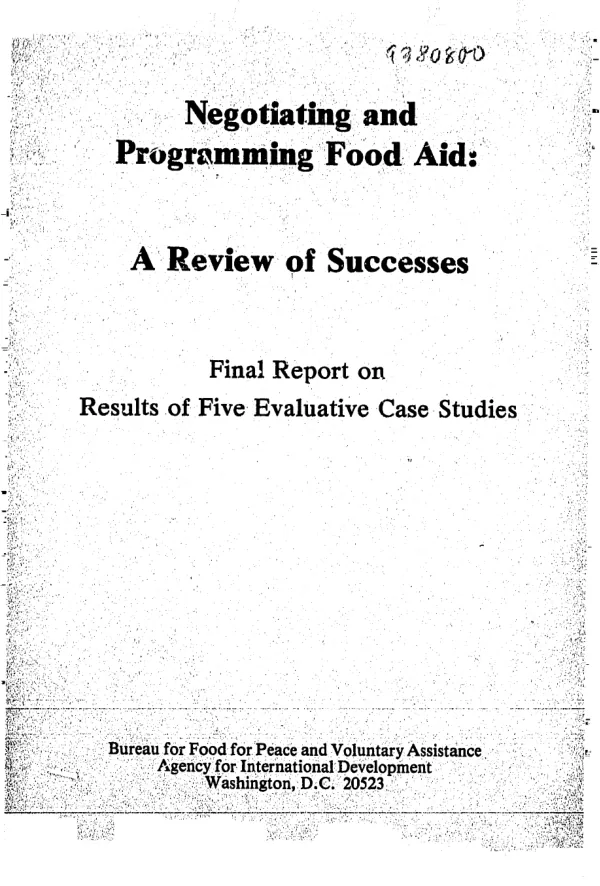
Negotiating and programming food aid : a review of successes; final report on results of five evaluative case studies
Sign inRONCO CONSULTING CORP.
Negotiating and programming food aid : a review of successes; final report on results of five evaluative case studies
Major findings and recommendations of case studies of P.L.
Morton, Alice L.; Newberg, Richard R. · 1986
Sign in to readA free account is required to download.
Abstract
480 food aid programs in Haiti, Mali, Pakistan, Tunisia, and Zambia are summarized. The case studies stressed (1) identification, negotiation, implementation, and monitoring of self-help measures (SHM"s); and (2) management and programming of local currency proceeds. Where appropriate, recommendations are categorized as applicable to A.I.D. Mission, AID/W, or Development Coordination Committee/Food Assistance Subcommittee (DCC/FAC) actions. The report also takes into account the host government (HG) perspective and includes recommendations to facilitate more effective HG participation in these bilateral processes. Broader, programmatic recommendations for A.I.D. and the DCC are presented as well, and summaries of the case studies are appended. Key lessons learned about policy dialogue in the P.L. 480 context were: (1) a mixture of informal and formal discussions and negotiations and reliance on relations of influence rather than of leverage or conditionality led to successful policy dialogue in each case; (2) joint programming of local currency can ease the HG"s burden in implementing stringent or politically difficult SHM"s; (3) continuity in seeking a few key policy reform goals is vital to success, as are simply-stated SHM"s, with easily measured benchmarks; (4) involving HG technicians in dialogue from the beginning is also important, while delaying the use of senior officials until later in the process makes their efficacy greater and maintains the substantive focus of SHM"s; and (5) integration of SHM"s with policy-related components of other A.I.D. programs can greatly assist policy dialogue and SHM performance.