USAID. MISSION TO EGYPT
Neighborhood urban services (NUS)
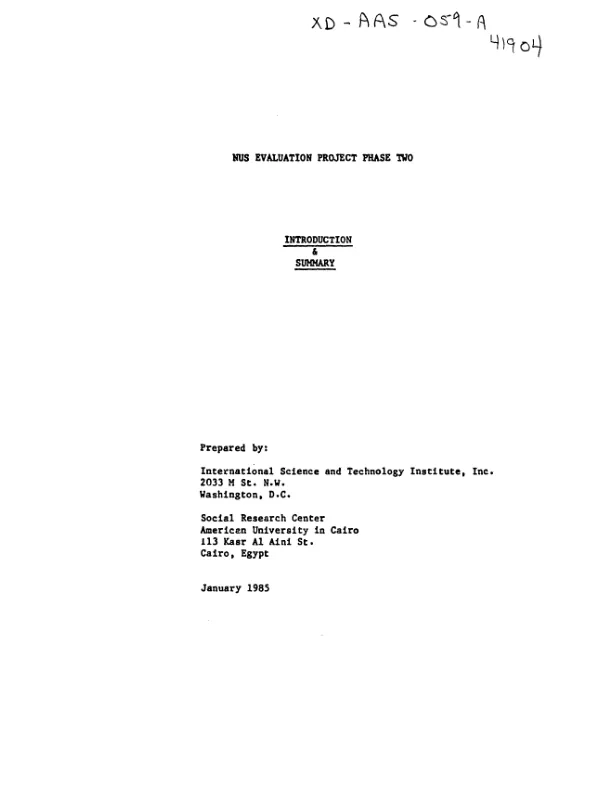
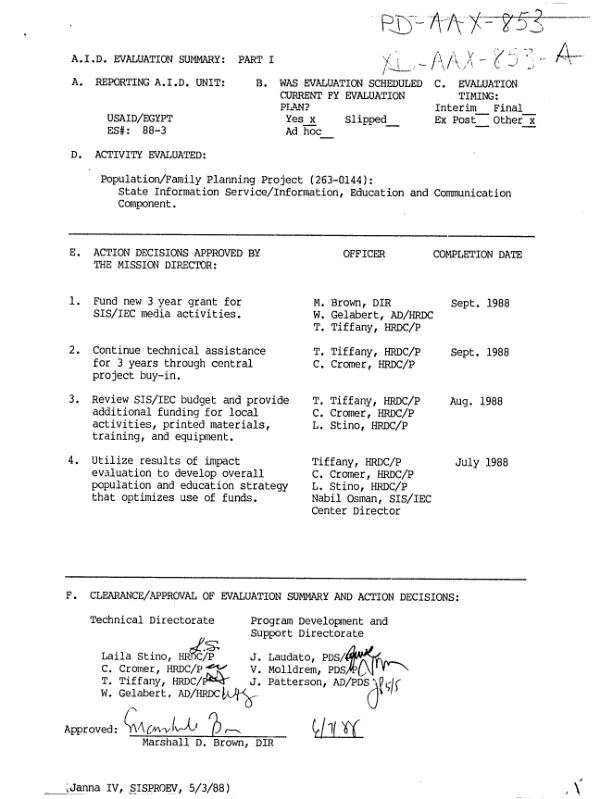
Evaluates project to develop the capacity of local government in greater Cairo and Alexandria to provide basic services to the poor.
Molldrem, V.; Tallat, R. · 1985
Sign in to readA free account is required to download.
Abstract
PES covers the period 3/84-12/84 and summarizes an attached special evaluation based in part on anecdotal evidence gathered during site visits. Progress is being made in local-level capacity building, construction of urban infrastructure, and PVO-provided services. Although clear, specific, long-term strategies for allocating resources and responsibility to local governments are still lacking, the project has upgraded local engineering capabilities, and the local decisionmaking process has successfully selected construction subprojects (SP"s) which reflect community needs. Lack of consultation with end-users during the design process has been a recurrent problem, however, which sometimes limits the utility of facilities constructed by local councils. Also, while the project has improved vertical linkages, it has had little impact on linkages within district government. While some 800 of 950 targeted SP"s (potable water, street lighting, schools, clinics, etc.) have been completed, a recent survey found that due to poor design and finishing work, 32% of these structures were in need of repair after their 1-year contractor warranty expired; contributing factors have been a shortage of design personnel and inadequate supervision. Management of maintenance funds has also been a problem. The funds have been released to district administrators rather than to the service directorates which operate SP facilities. Development of a parallel project maintenance system could further weaken the directorates. Also, the Egyptian government has taken too long to release maintenance and incentive funds, and the latter are too late and inadequate to affect staff motivation. Some 1,000 grants have been made to PVO"s (mostly for equipment to improve PVO nurseries, training/sewing centers, and clinics). However, fewer PVO"s than expected have been eligible for project assistance, and the grants could have had a greater impact if used to upgrade PVO organizational capacity and expand services. More positively, training of PVO leaders and staff and introduction of new services has intensified the project"s impact on PVO"s. (Near East Abstract, modified)
Related documents
![Local development II [LD II], 263-0182](https://covers.devme.ai/gen/36480.webp)