USAID DEC
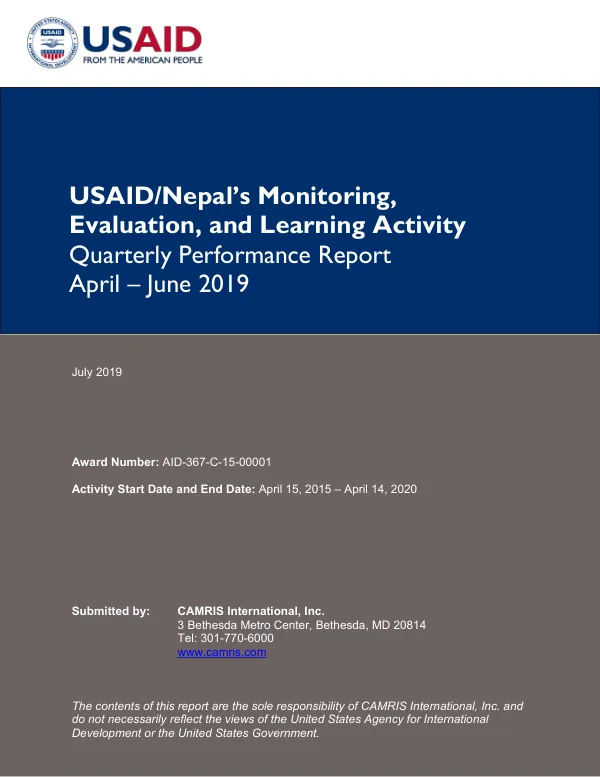
Nepal Monitoring, Evaluation, and Learning (MEL) Activity’s Quarterly Performance Report for April – June 2019
Sign inUSAID
Nepal Monitoring, Evaluation, and Learning (MEL) Activity’s Quarterly Performance Report for April – June 2019
The Monitoring, Evaluation, and Learning (MEL) Activity supports the achievement of the U.S.
2019 · 31 pages
Sign in to readA free account is required to download.
Abstract
Agency for International Development (USAID)/Nepal's Development Objectives by increasing the Mission's learning through more rigorous monitoring and evaluation (M&E) of development activities. The MEL Activity has three components, which are designed to enhance the Mission's M&E capacity and promote gender equality and the inclusion of marginalized populations. Component 1: Support Greater Rigor and Coherence in USAID/Nepal's M&E Efforts focuses on providing technical assistance to the Mission's performance management plan (PMP) and project- and activity-level MEL plans. This component also aims to strengthen the capacity of USAID/Nepal staff to conduct M&E tasks and use data more effectively to inform decision making. Additionally, it seeks to strengthen the performance monitoring capacity of USAID/Nepal's implementing partners (IPs). Component 2: Design and Conduct Analyses, Evaluations, Surveys, Studies, and Assessments involves conducting performance and impact evaluations, as well as surveys, studies, assessments, and analyses. This component aims to provide the Mission with evidence-based information to inform its decision making and program implementation. Component 3: Support Improved Knowledge Management within the Mission focuses on assisting the Mission to improve its knowledge management (KM) and collaborating, learning, and adapting (CLA) practices. This includes the use of AIDTracker Plus (AT+) and other USAID performance monitoring and KM systems. The MEL Activity has made significant progress in the first quarter of 2019. In Component 1, the Activity has provided technical assistance to the Mission's PMP and MEL plans, and has strengthened the capacity of USAID/Nepal staff to conduct M&E tasks. In Component 2, the Activity has conducted several evaluations, surveys, and studies, including the Hariyo Ban II Impact Evaluation Baseline and the Baseline Study for Knowledge-Based Integrated Sustainable Agriculture in Nepal II (KISAN II). In Component 3, the Activity has facilitated learning summits and communities of practice, and has provided technical assistance to IPs on CLA case submission. The MEL Activity has also made progress in developing its knowledge management processes, including the development of guidelines on the Development Data Library and the Learning Lab Portal: The Nepal MEL Group. Additionally, the Activity has published a briefer on the Gender Equality and Social Inclusion (GESI) Summit. Overall, the MEL Activity has made significant progress in supporting the achievement of USAID/Nepal's Development Objectives and promoting gender equality and the inclusion of marginalized populations. The Activity continues to work towards its goals and objectives, and is committed to providing high-quality technical assistance and support to the Mission. The MEL Activity has also identified several challenges and areas for improvement, including the need to strengthen the capacity of USAID/Nepal's IPs to conduct M&E tasks and use data more effectively. Additionally, the Activity has identified the need to improve its knowledge management practices and to develop more effective systems for tracking and reporting on its progress. In the next quarter, the MEL Activity plans to continue its work on Component 1, including providing technical assistance to the Mission's PMP and MEL plans. In Component 2, the Activity plans to conduct several evaluations, surveys, and studies, including the Mid-Term Performance Evaluation of the Global Health Supply Chain – Procurement and Supply Management Project. In Component 3, the Activity plans to continue its work on developing its knowledge management processes and to provide technical assistance to IPs on CLA case submission.