ABT ASSOCIATES
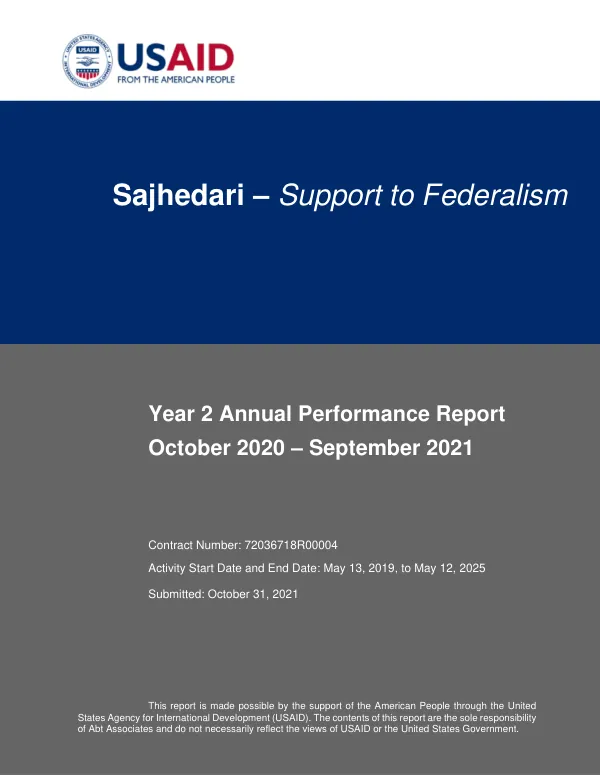
Sajhedari - Support to Federalism Monitoring, Evaluation, and Learning (MEL) Plan
Nepal's transition to a republic-based multi-party democracy began in 2006 following the end of a 10-year civil war.
2021 · 95 pages
Sign in to readA free account is required to download.
Abstract
The Comprehensive Peace Agreement led to the adoption of a new constitution in 2015, which established a three-tier governance system consisting of central, provincial, and local governments. Each tier has an executive and an elected representative branch, with the district level serving as an intermediate coordination level. The judicial branch is based on district-level courts. The 2015 Constitution also created seven new provinces or states, addressing demands for identity-based federalism. However, only a few provinces have agreed on a name, and Madhesi-based political parties continue to insist on their demands. The 2017 elections saw an alliance of communist parties sweep the polls, which have since merged into the Nepali Congress Party (NCP). The NCP's potential to avoid factionalism may lead to a period of unprecedented political stability in Nepal. The Sajhedari - Support to Federalism initiative aims to support Nepal's federalism process. The initiative is guided by several principles, including agility and results-focused approaches, adaptability, flexibility, and responsiveness, creativity and cost-effectiveness, tailored programming with a broad view, and equity-focused programming. These principles are designed to ensure that the initiative is effective in supporting Nepal's federalism process. The initiative's Theory of Change (TOC) outlines the expected outcomes and pathways for achieving these outcomes. The TOC is based on the assumption that the initiative's activities will lead to improved governance, increased citizen engagement, and enhanced economic development. The initiative's Monitoring, Evaluation, and Learning (MEL) approach is designed to track progress towards these outcomes and identify areas for improvement. The MEL plan outlines the structures and functions for monitoring and evaluation, including indicators, baseline data, and targets. The plan also outlines the types of indicators to be tracked, including performance indicators, and the performance indicator tracking table and reference sheets. Additionally, the plan outlines the approach for monitoring the context and assumptions, including data collection and management, monitoring approaches, data security, data analysis and reporting, communication and dissemination, routine reporting, data quality, and coordination and collaboration.
Related documents