USAID DEC
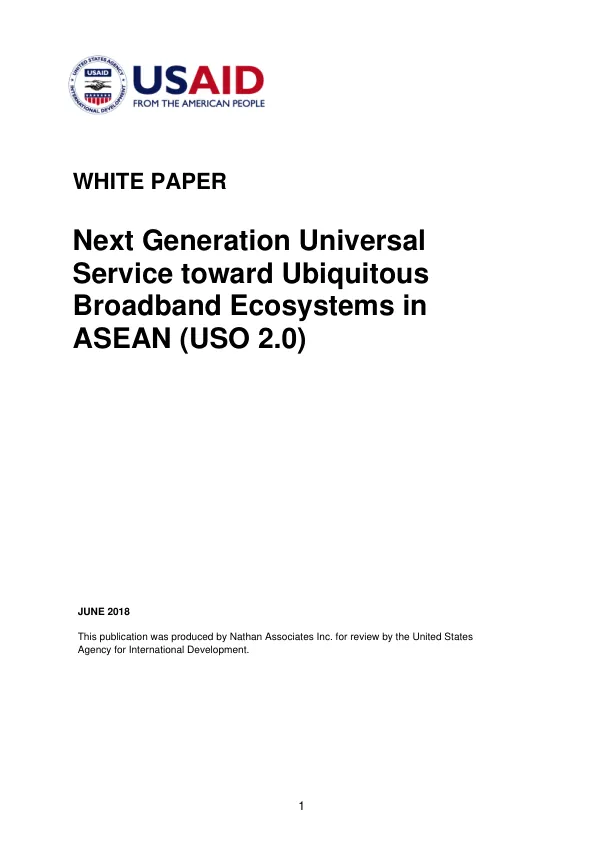
Next Generation Universal Service toward Ubiquitous Broadband Ecosystems in ASEAN (USO 2.0)
Sign inROBERT NATHAN ASSOCIATES
Next Generation Universal Service toward Ubiquitous Broadband Ecosystems in ASEAN (USO 2.0)
The Next Generation Universal Service toward Ubiquitous Broadband Ecosystems in ASEAN (USO 2.0) initiative began in 2018 with the goal of promoting widespread access to broadband services across the Association of Southeast Asian Nations (ASEAN) region.
2018 · 60 pages
Sign in to readA free account is required to download.
Abstract
The initiative was written for the United States Agency for International Development (USAID) and was submitted by Nathan Associates Inc. under contract AID-486-C-13-00004, ASEAN Connectivity through Trade and Investment (US-ACTI). The USO 2.0 initiative aims to address the challenges of market inefficiency and access gaps in the broadband sector. Market inefficiency refers to the lack of competition and high prices in the broadband market, while access gaps refer to the disparities in broadband access between urban and rural areas. To address these challenges, the initiative proposes updating and enhancing universal service funds (USFs) to make them more effective in promoting broadband access. The USF is a fund established by governments to provide subsidies to telecommunications operators to extend broadband services to underserved areas. However, the performance of USFs has been criticized for being inefficient and ineffective in promoting broadband access. To address these criticisms, the initiative proposes enhancing USF institutional planning and operations, as well as introducing complementary and alternative funding approaches. One of the key complementary funding approaches proposed by the initiative is the use of public-private partnerships (PPPs). PPPs involve collaboration between the public and private sectors to deliver broadband services to underserved areas. The initiative highlights the Palapa Ring PPP in Indonesia as an example of a successful PPP model. The Palapa Ring PPP is a project that aims to provide broadband services to remote areas in Indonesia through a network of fiber-optic cables. The initiative also proposes the establishment of community ICT centers (CICs) to provide access to broadband services for rural communities. CICs are community-based facilities that provide access to broadband services, computers, and other digital tools. The initiative proposes that CICs be established in rural areas to provide access to broadband services for rural communities. In addition to CICs, the initiative proposes the establishment of institutional connectivity programs to provide broadband access to institutions such as schools, hospitals, and government offices. Institutional connectivity programs aim to provide broadband access to institutions that are critical to the development of the economy and society. The initiative also proposes the establishment of ICT demand support and stimulation programs to promote the adoption of broadband services among rural communities. These programs aim to promote the adoption of broadband services by providing training and support to rural communities. The initiative provides case examples of USO policies in six ASEAN countries, including Indonesia, Malaysia, Thailand, Vietnam, the Philippines, and Cambodia. The case examples highlight the challenges and opportunities faced by each country in promoting broadband access. The initiative also proposes scenarios for adapting future USO policies to technological change. The scenarios highlight the trends in technology evolution and their implications for USO policies. The initiative proposes that USO policies be adapted to take into account the changing technology landscape and the emerging trends in the broadband sector. The implications of the initiative for USO objectives and principles are also discussed. The initiative proposes that USO policies be based on general principles such as universality, equity, and efficiency. The initiative also proposes priorities for ASEAN USO policies, including the promotion of broadband access, the development of digital literacy, and the promotion of ICT affordability. Overall, the USO 2.0 initiative provides a comprehensive framework for promoting broadband access across the ASEAN region. The initiative highlights the challenges and opportunities faced by each country in promoting broadband access and proposes a range of solutions to address these challenges.
Related documents