USAID DEC
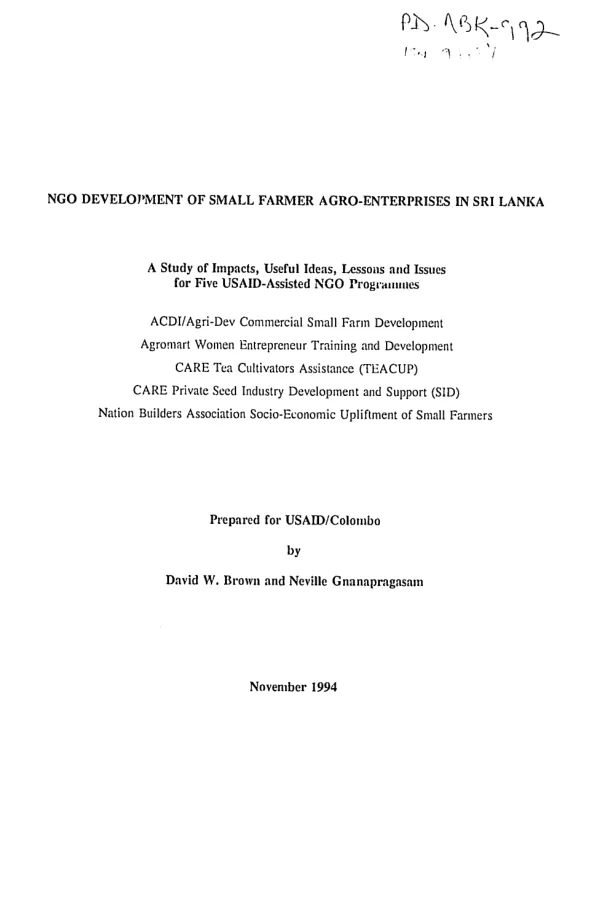
NGO development of small farmer agro-enterprises in Sri Lanka : a study of impacts, useful ideas, lessons and issues for five USAID-assisted NGO programmes
Sign inUSAID. MISSION TO SRI LANKA
NGO development of small farmer agro-enterprises in Sri Lanka : a study of impacts, useful ideas, lessons and issues for five USAID-assisted NGO programmes
Evaluates five USAID-assisted NGO projects to stimulate small-scale agro-enterprise in Sri Lanka: Agri-Dev Commercial Small Farm Development (Agricultural Cooperative Development International -- ACDI); Women Entrepreneur Training and Development (Agromart Foundation Societies); Tea Cultivators Assistance (TEACUP) and Private Seed Industry Development and Support (SID) (sponsored by CARE); and Socio-Economic Upliftment of Small Farmers in North Western Province (Nation Builders Association).
Brown, David W.|Gnanapragasam, Neville · 1994
Sign in to readA free account is required to download.
Abstract
The evaluation included interviews with participating farmers/entrepreneurs. Earnings from NGO-induced enterprises have generally been modest, in the range of Rs 20,000-50,000 ($400-1,000) per year for participating farm families. However, the gains, though modest, are very meaningful to these families, who may live at the edge of subsistence. Financing requirements for new enterprises, which range from Rs 5,000 to 10,000 or more, were identified as the largest hurdle to business start-ups. Current financing avenues, which include small group revolving funds and seasonal loans from contract buyers, are not adequate to meet needs; ways must be found to get banks involved in lending to small farmers. In this regard, land titling procedures, group guarantees, and other procedural requirements were identified as the major obstacles to greater bank involvement. However, once beyond the start-up hurdle, innovative groups and individuals seem to find ways to expand on their own. The following were identified by beneficiaries as particularly valuable aspects of the NGO programs: (1) NGOs' key role in inspiring and energizing new enterprise formation by small farmers and their families; (2) the entrepreneurship, business, and financial management training, as well as the technical training and field staff provided; (3) NGOs role in forming and reinforcing local farmer groups; (4) assistance in arranging start-up financing; and (5) the "intangible" growth of local self-confidence and initiative that the NGO programs are promoting. Areas where the NGO programs fell short or need strengthening are as follows. (1) Local entrepreneurs' access to information about national and overseas markets is poor. (2) NGOs tend to rely too heavily on the success of single enterprises, and too often continue to focus on enterprises that are doing well (and that are examples of success) while neglecting to stimulate new start-ups and/or assist enterprises that are struggling. (3) Only limited attention is given to environmental concerns, the growth of farm worker capabilities, and financial and legal arrangements for intergenerational transitions of agro-enterprises. (4) The spread effects of innovations to nearby areas have been limited. (5) The NGOs seem to lack clear strategies or aims in regard to their role in supporting enterprises which are ready to move, or have moved, into the commercial expansion phase. (6) Planning for post-project sustainability and growth has been inadequate. A key lesson to be drawn from the projects is that considerable latent agro-entrepreneurial talent and interest exists among both men and women in Sri Lanka's rural and semirural areas. Furthermore, there are numerous skilled, motivated people in Sri Lanka -- government employees, retired agriculturalists and managers, and others -- who are interested in assisting small farmers and who represent a resource which has been essentially untapped by the NGOs.