CHEMONICS INTERNATIONAL, INC.
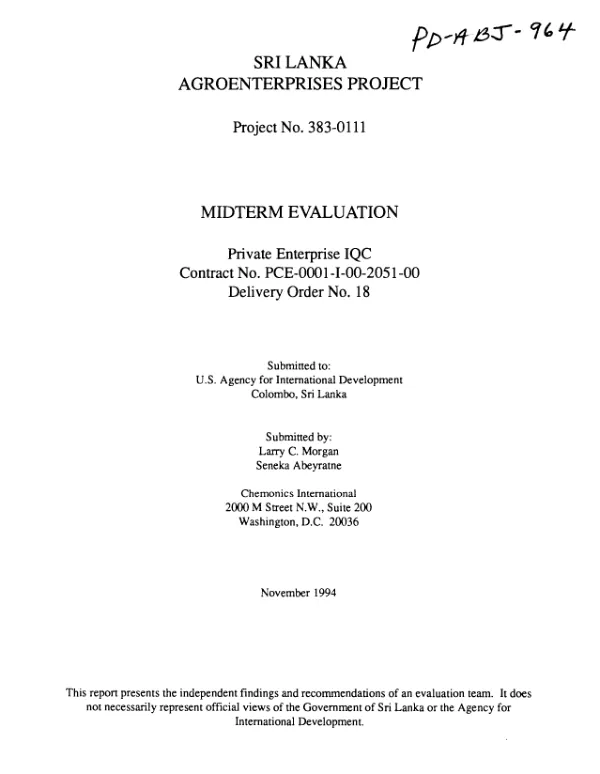
Sri Lanka agroenterprises project : midterm evaluation
Evaluates project to expand agro-industrial enterprises and support the diversification and commercialization of Sri Lanka's agricultural sector.
Morgan, Larry C.|Abeyratne, Seneka · 1994
Sign in to readA free account is required to download.
Abstract
Mid-term evaluation covers the period 5/92-11/94. The project has set appropriate output targets and annual work plans, which have led to the introduction of new technologies and the development of markets and new financial mechanisms. Although the rate of investment has been only about one-half of the cumulative output targets, the client base is expanding rapidly and past investments are building momentum within existing client firms and their competitors. The project has been highly effective in improving the entrepreneurial behavior of its clients (who include micro, small, and medium-sized firms, and female and non-English speaking entrepreneurs), who are demonstrating the capacity to exploit project assistance well beyond the project's planned life. Cost-sharing investments in innovative technologies with clients are stimulating client confidence and fostering prudent financial management behavior. In addition, client competitors are benefiting from the knowledge generated by client technology adoption programs. Training has been localized in order to focus on country-specific enterprise development issues and save overseas training costs. While significant headway has been made in collaborative training and market development activities with key host country institutions, progress has been slow in improving public sector support for agro-enterprises, so that there is no assurance of the project's impact beyond its life. Currently, there is no private or public organization that is a viable candidate to assume the project's advisory role. The project is using an efficient monitoring and evaluation (M&E) system, which would be strengthened by refinement of the project's purpose-level indicators. It has also developed an effective procedure for detecting possible adverse environmental effects of its activities; so far, none have been found, although the use of pesticides/fungicides in crop production trials should be evaluated to see if more comprehensive environmental compliance procedures are warranted. The following are lessons learned. (1) The project's advisory board is staffed mainly by progressive agro-entrepreneurs from the private sector, whose perspectives provide effective guidance on strategic implementation issues and who have created a platform for stimulating public sector support for agricultural development. (2) The advisory team's aggressive promotion campaign has secured a solid client base and established the level of momentum necessary to achieve the project's performance targets. (3) The decision to initially concentrate on selecting clients from established, rather than new, firms has allowed the project to identify highly productive investment and technology transfer opportunities and avoid a high rate of business failures.
Related documents