ACCENTURE DEVELOPMENT PARTNERSHIPS
Niger COVID-19 Vaccination Program in Review
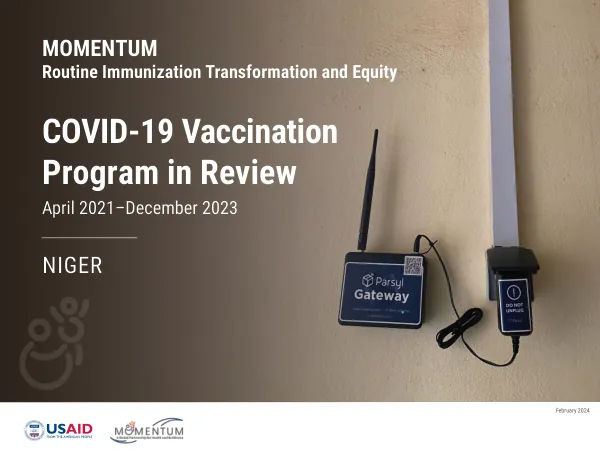
The MOMENTUM Routine Immunization Transformation and Equity project in Niger aimed to increase equitable immunization coverage in the country.
2024 · 16 pages
Sign in to readA free account is required to download.
Abstract
Funded by the U.S. Agency for International Development (USAID), the project was implemented by JSI Research & Training Institute, Inc. (JSI), along with PATH, Accenture Development Partnerships, Results for Development, and CORE Group. The project's primary goal was to strengthen the health system in Niger, particularly in the areas of supply chain management and cold chain maintenance. Niger, a landlocked country in West Africa, faces significant challenges in its health system, including a lack of funding, limited transport availability, and a shortage of health workers. The country has the region's lowest ratio of health workers, with only 0.25 health workers per 1,000 people. This shortage has led to service delivery issues and larger health systems challenges that can impact policies, supplies, and support efforts. The first COVID-19 case was reported in Niger on March 19, 2020, and as of December 4, 2023, 49 percent of eligible people in Niger had been fully vaccinated. The project provided targeted technical support to strengthen supply chain management for the COVID-19 vaccination program country-wide. This included aligning COVID-19 service delivery strategies with tailored supply chain approaches to support sub-national rollout. The project also fostered the application of supply chain best practices, including warehousing and security measures for approved vaccines, and robust temperature monitoring and tracking for the different vaccines in the system. Strengthening cold chain maintenance was a key technical area of support for the project. This included planning, policy, and coordination, improving safe waste management, improving vaccine temperature monitoring, and data quality, management, and use. The project began supply chain technical support to the national level and in seven regions in April 2021. This support included procuring Parsyl devices to monitor the temperature of cold chain equipment, collecting data for a human-centered design study on cold chain maintenance, and reinforcing components of the supply chain by purchasing security systems, fire alarms, batteries, and tires. The project also supported a vaccination campaign against COVID-19 in Niamey and a WHO-led workshop on data triangulation related to the COVID-19 vaccine. In addition, the project conducted a waste management workshop to align standard operating procedures across multiple divisions of the government and finished the installation of Parsyl cold chain temperature monitoring devices. The project also supported the first nationwide mass vaccination campaign against COVID-19 and procured and installed eight security cameras in the national vaccine warehouse. A human-centered design study on cold chain maintenance was conducted in February 2023, resulting in concrete actionable ideas to improve cold chain maintenance. The project also conducted a cold chain maintenance co-creation workshop in March 2023, resulting in innovative solutions for the maintenance system. The project supported the seventh nationwide mass vaccination campaign against COVID-19 in June 2023. The project's efforts have led to significant improvements in the health system in Niger. Trained 398 supply chain technicians on COVID-19 vaccine and cold chain management. Updated temperature monitoring and maintenance standard operating procedure (SOP) that is pending approval by the Directorate of Immunization (DI) and the National Logistics Working Group (NLWG). Conducted 60 supportive supervision visits in Zinder, Maradi, and Tahoua regions to reinforce supply chain management best practices. Developed and operationalized vaccine waste management SOPs in eight project regions. Conducted a human-centered design study that resulted in concrete actionable ideas to improve cold chain maintenance. Provided logistic, supportive supervision, and coordination support for seven COVID-19 mass vaccination campaigns in three regions. The project's success is a testament to the importance of strengthening health systems in low-resource settings. By providing targeted technical support and fostering the application of supply chain best practices, the project has helped to improve the health system in Niger and increase equitable immunization coverage in the country.