COUNTER PART INTERNATIONAL
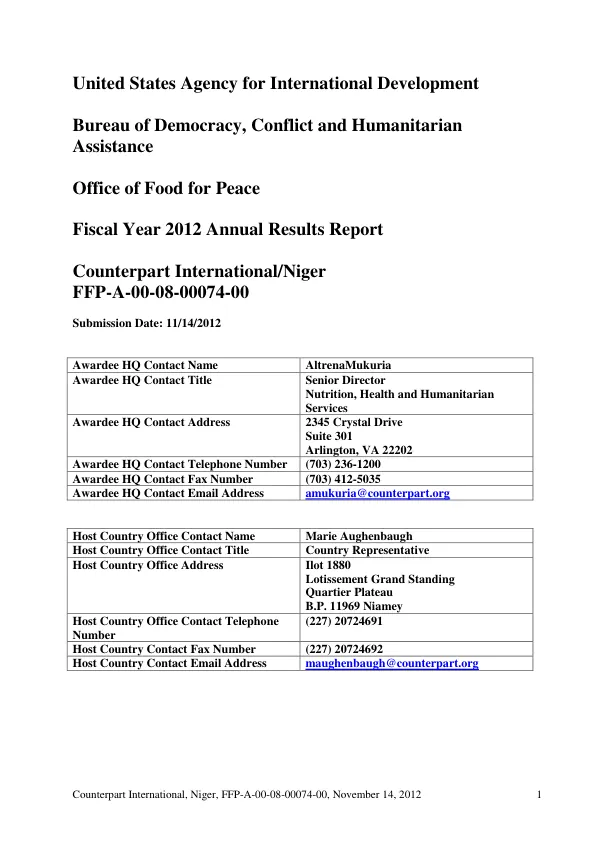
Fiscal Year 2012 Annual Results Report
The agricultural development initiative in Niger began in 2012 with funding from the United States Agency for International Development's Food for Peace Program.
2012 · 13 pages
Sign in to readA free account is required to download.
Abstract
Initial assessments conducted in the Gouré and Maine Soroa departments identified soil degradation and limited market access as primary challenges. Crop yields averaged 40% below regional benchmarks, particularly for staple crops including millet and sorghum. Implementation focused on improving health and nutrition behaviors among caretakers, pregnant/lactating women, and adolescent girls. Counterpart International, in partnership with the Government of Niger, established 215 cereal banks to improve access to cereals. The cereal banks were monitored for decision-making procedures, stock management, organization of sales sessions, stock replenishment, commodity pricing, indebtedness of members, management of committee members, financial management, and status of bank accounts. Training programs were conducted for cereal bank management committees, covering roles and responsibilities of committee members, good governance, marketing strategy, funds securing, and stock management. The training was facilitated by the Chief of the Agricultural District Office and the Maine Soroa Agriculture Department Director. Technical support was provided to all cereal bank committees and their members as needed. The results of the cereal bank activities showed that 100% of the target beneficiaries were reached, with 1,505 men and 1,505 women trained in cereal bank management. Additionally, 215 cereal banks secured a bank account, with 85 of them being sustainable. The cereal banks were able to achieve a 100% achievement rate in terms of trained COGES members, with 215 COGES members trained in FY12. The nutritional situation in Niger remained a concern, with a countrywide global acute malnutrition rate of 14.8%, according to the 2006 WHO norms. The rate increased compared to the June 2011 survey (12.3%), but decreased compared to the 2010 report (16.7%). In the case of severe acute malnutrition, the rate increased from 1.9% in June 2011 to 3.0% this year. The prevalence of severe acute malnutrition returned nearly to the rate observed in 2010 (3.2%). The Government of Niger maintained its policies and priorities on the health and food security sectors. The 2012 harvest was expected to be better than 2011, but the yield would not allow the producers to fully recover due to several years of recurring drought and bad agro-pastoral harvest. Continued assistance was required to improve the food security situation through the use of improved seeds in arid areas and wetland farming. The mid-term evaluations conducted in November 2011 confirmed that the first 3 years of the Multi-Year Assistance Program (MYAP) had produced positive results against the majority of baseline indicators. Age-for-weight scores decreased from 43.3% at baseline to 33.9% at mid-term. However, weaknesses were identified in terms of the efficiency of integrated approaches designed to promote antenatal and post-partum care, micronutrient supplementation, immunization, and treatment of major childhood illness.