USAID FAMINE EARLY WARNING SYSTEMS NETWORK
NIGER Perspective sur la sécurité alimentaire
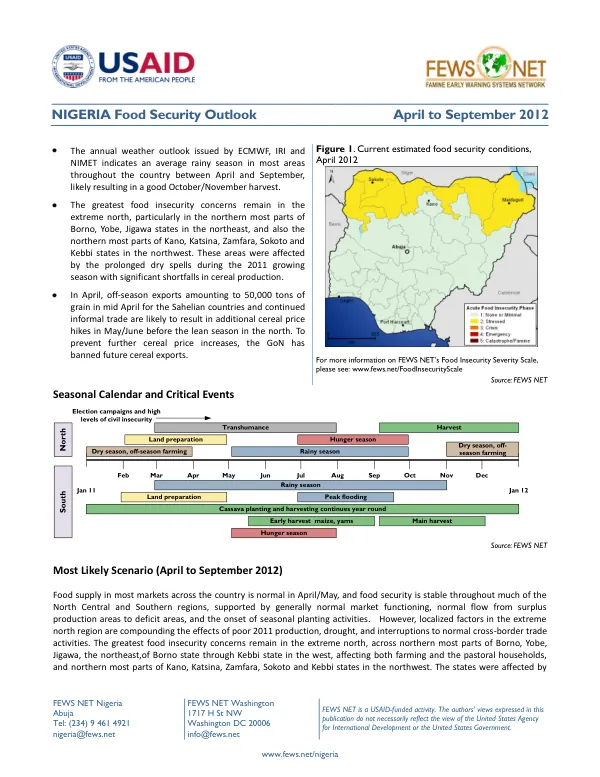
The agricultural development initiative in Niger began with the influx of 26,540 Malian refugees since January, increasing cereal demand by approximately 460 MT per month.
2012 · 7 pages
Sign in to readA free account is required to download.
Abstract
The food needs of this refugee population are currently being met by humanitarian aid organizations. However, the government assistance plan does not take refugee food needs into account. Grain markets in Niger are performing well, with prices stable since last month, though they remain 20 to 30 percent above the same time last year and the five-year average. Current food aid programs are not expected to significantly reduce grain demand, which is expected to remain strong between May/June and September, fueled by the return of migrant workers, the influx of refugees, and consumption requirements associated with the observance of Ramadan. In agropastoral areas of Filingué, Ouallam, Tillaberi, and Téra departments, food insecurity will reach IPC Phase 3: Crisis in July, August, and September due to mediocre 2011 harvests, high cereal prices, and an assumption that likely emergency assistance will be insufficient to fully meet needs. Contrary to assumptions made in January, migrating livestock did not leave early or have returned to Niger due to conflicts in Mali and Nigeria, resulting in the depletion of rangeland resources at a more rapid rate than expected in the pastoral departments of Abalak, Tchintabaraden, and Tanout. According to Livestock Market Information System (SIMB) data for the month of March, livestock prices were stable compared with previous months and above seasonal averages, putting terms of trade for male goats/millet 10 to 17 percent above the five-year average. With milk supplies at 50 percent below-average and prices at double the average, there should be no radical changes in income from milk sales. The first round of the assistance program for at-risk populations, beginning in November of last year and running through January of this year, helped a total of 105,000 households, including 70,000 households through cash-for-work activities and 35,000 households through food-for-work activities, providing the financial equivalent of approximately 7.88 billion CFA francs worth of aid. There was a large (67 percent) jump in admissions of malnourished children to health centers between February and March, though this is not necessarily unusual, as historical data for 2007 through 2011 shows that admissions rates often double between January and May. Basic assumptions for the period from April to September 2012 include the current status quo with respect to the balance of power in Mali, with increasingly frequent acts of banditry along the country's northern border with Niger, but without producing any further large-scale population movements or major disruptions in cross-border trade in grain or livestock. Additionally, there has been a large improvement in security conditions and informal grain trade in Nigeria since the unilateral closing of its borders, though trade flows have not rebounded to their pre-closure levels.