USAID/NIGERIA
Nigeria HPN Sustainability Brief_FS-23-636 D4I
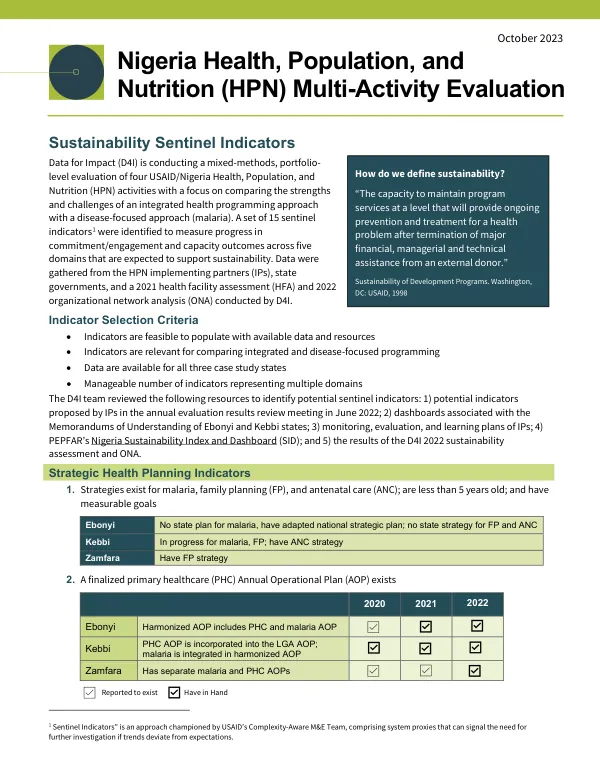
Strategic health planning indicators are used to measure the existence of state-level strategies for malaria, family planning (FP), and antenatal care (ANC).
2023 · 8 pages
Sign in to readA free account is required to download.
Abstract
The indicators assess whether these strategies are less than five years old and have measurable goals. The results show that Kebbi and Zamfara states have strategies in progress for malaria and FP, while Ebonyi state does not have state-level strategies for any of these areas. A finalized primary health care (PHC) Annual Operational Plan (AOP) is also an indicator of strategic health planning. All three states have met the benchmark for having a finalized PHC AOP in place by 2022. Health financing indicators measure the percentage of general state health expenditure as a proportion of the general state budget. The results show that Kebbi state has the highest percentage of general state health expenditure, at 88.3% in 2021, while Ebonyi state has the lowest percentage, at 77.5% in 2021. Governance and leadership indicators measure the percentage of primary health care (PHC) facilities that offer family planning (FP), antenatal care (ANC), and other services. The results show that Kebbi state has the highest percentage of PHC facilities offering these services, at 85% in 2021, while Zamfara state has the lowest percentage, at 62% in 2021. Human resources for health (HRH) indicators measure the percentage of PHC facilities with at least five healthcare workers. The results show that Kebbi state has the highest percentage of PHC facilities with at least five healthcare workers, at 74% in 2021, while Zamfara state has the lowest percentage, at 46% in 2021. Community participation and accountability indicators measure the relative betweenness centrality (RBC) of community organizations in information and resource sharing networks. The results show that Zamfara state has the highest RBC of community organizations in resource sharing, at 84% in 2021, while Ebonyi state has the lowest RBC, at 63% in 2021. Access to essential drugs, diagnostics, and supplies (EDDS) indicators measure the percentage of facilities with malaria rapid diagnostic tests (mRDTs) and stockouts of mRDTs and Artemisinin-based combination treatment (ACT). The results show that Kebbi state has the highest percentage of facilities with mRDTs in stock, at 85.7% in 2021, while Zamfara state has the lowest percentage, at 80% in 2021. The summary state comparison of indicator status shows that Kebbi state tends to perform best across the different domains, except for availability of EDDS, where it typically ranks second. Zamfara state performs best in the malaria-focused approach, while Ebonyi state performs best in the combined approach. However, Ebonyi state tends to be weakest in the health financing, HRH, and community participation and accountability domains, while Zamfara state tends to be weakest in the governance and leadership domain and EDDS domain.