CAROLINA POPULATION CENTER AT THE UNIVERSITY OF NORTH CAROLINA AT CHAPEL HILL
2022 Nigeria HPN Multi-Activity Sustainability Assessment Results
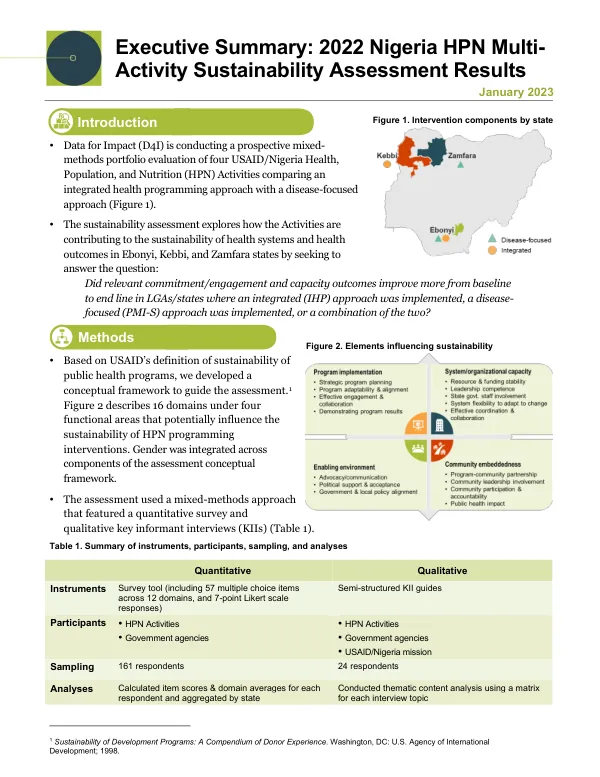
The prospective mixed-methods portfolio evaluation of four USAID/Nigeria Health, Population, and Nutrition (HPN) Activities was conducted by Data for Impact (D4I) to compare an integrated health programming approach with a disease-focused approach.
2023 · 2 pages
Sign in to readA free account is required to download.
Abstract
The evaluation aimed to assess the sustainability of health systems and health outcomes in Ebonyi, Kebbi, and Zamfara states. A conceptual framework was developed based on USAID's definition of sustainability of public health programs, which identified 16 domains under four functional areas that potentially influence the sustainability of HPN programming interventions. The assessment used a mixed-methods approach featuring a quantitative survey and qualitative key informant interviews. The survey tool included 57 multiple-choice items across 12 domains and 7-point Likert scale responses, while the semi-structured key informant interview guides were used to gather information from HPN Activities, government agencies, and USAID/Nigeria mission staff. The results of the assessment showed that USAID/Nigeria HPN Activities are contributing to sustainable state health systems and outcomes. All three states scored consistently high in 'program implementation' and 'enabling environment' functional areas, with Ebonyi scoring highest across all domains of 'program implementation'. The assessment also highlighted the importance of coordination and advocacy with government stakeholders, with respondents citing challenges such as busy schedules, limited competency among stakeholders, and competing priorities. However, the results also showed that assessment survey scores were lowest for system and organizational capacity, with many item averages in the 'small' to 'average' range. Limited funding and human resources continue to constrain state governments' capability to fully own and independently implement HPN approaches. The results of this assessment are baseline findings, and evidence on the effectiveness of HPN Activities' health programming approaches in increasing commitment/engagement and capacity is still limited. The differences between states are small, and both integrated and malaria-focused approaches incorporate multiple elements expected to contribute to sustainability. The larger context at the state level, including political economy, interpersonal dynamics, and expectations, seems to have a larger influence on progress toward sustainability than the integrated vs. disease-focused approach. Structural constraints, such as funding, human resources, and timeline, limit progress toward sustainability in both program models and are largely outside the control of the implementing partners.