JOHNS HOPKINS UNIVERSITY
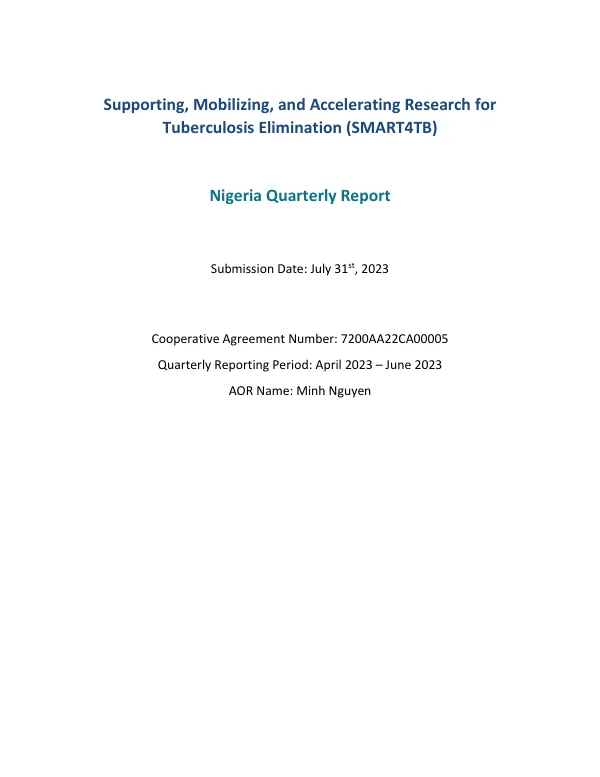
Nigeria Quarterly Report
The SMART4TB program in Nigeria aims to evaluate the diagnostic accuracy and acceptability/usability of novel point-of-care (POC) tuberculosis (TB) diagnostics in adults with presumptive TB.
2024 · 8 pages
Sign in to readA free account is required to download.
Abstract
The program is a collaborative effort between Johns Hopkins University, KNCV Tuberculosis Foundation, and Zankli Research Center, with funding from the United States Agency for International Development (USAID). The program's overall goal is to standardize and implement the study protocol for the evaluation of diagnostic accuracy and test acceptability/usability in Nigeria. Key achievements and deliverables submitted include the development and finalization of a standardized study protocol, site preparation, participant enrollment, and study data quality and assurance activities. As of the end of December 2023, 147 participants had been enrolled in the study, with a weekly enrollment report provided to the team and discussed in the weekly meeting. The study PI from the Zankli Research Center attended the UNION conference in Paris, where he met with key stakeholders and exchanged experiences with study coordinators. The program has also made progress in adapting new SOPs for sputum and mouth swab collection and testing, with plans to implement new strategies to further improve follow-up activities. A site visit is planned for March 2024 to assess the program's progress and provide technical assistance as needed. In-country coordination and collaboration are essential components of the program, with regular meetings and travel channels to ensure effective program management. Key partners include KNCV, KNCV Nigeria, the Nigeria National Tuberculosis and Leprosy Control Program (NTBLCP), and the Zankli Research Center. The Early-Stage Investigator (ESI) program is another key component of the SMART4TB program, aiming to prepare researchers in the early stage of their careers to become independent researchers. The program will train ESI from countries engaged in SMART4TB research protocols under Technical Areas 1 and 2, with eligible ESI applicants paired with a local senior research mentor and a co-mentor from the protocol team. The program is awaiting approval for Cohort 2, with plans to send out emails announcing the initiation and recruitment of the ESI program application for Phase 1 for Cohort 2. During Phase 1, all interested applicants will have the opportunity to participate and receive core training, with investigators participating in Phase 1 required to submit a research proposal concept sheet indicating their preparedness to progress further in the program. The program's financial report shows a total obligated amount of $120,556, with $49,643 expended in the prior quarter and $49,482 expended in the reporting quarter. The remaining balance is $21,431.00, with funding from the USAID.
Related documents