JHPIEGO
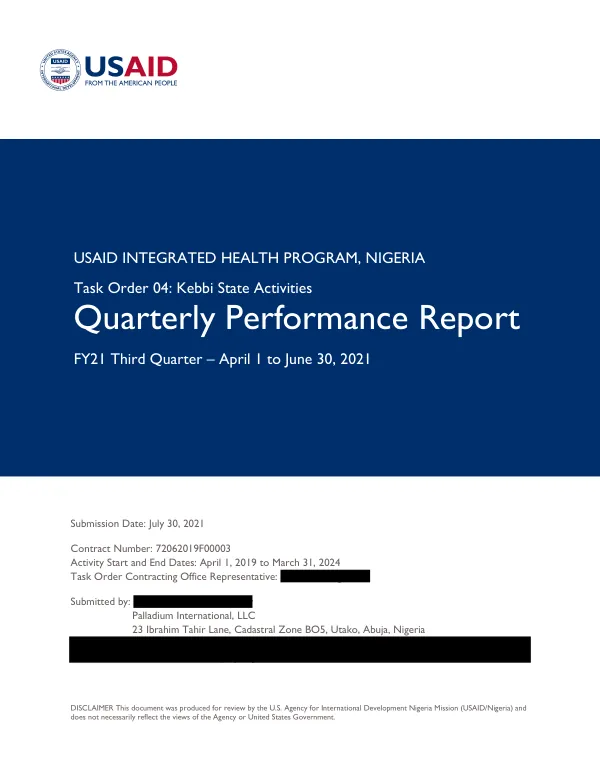
Task Order 04: Kebbi State Quarterly Performance Report, FY21 Quarter 3
The USAID Integrated Health Program (IHP) Task Order 4 for Kebbi State is a five-year contract with a ceiling of $47,168,691.
2021 · 46 pages
Sign in to readA free account is required to download.
Abstract
Its goal is to contribute to state-level reductions in child and maternal morbidity and mortality and increase the capacity of health systems to sustainably support primary health care services. IHP Kebbi partners with the government, non-governmental organizations, and the private sector to achieve its objectives: strengthen systems support primary health care services, improve access to primary health care services, and increase the quality of primary health care services. IHP Kebbi has made progress in strengthening health systems, improving access to primary health care services, and increasing the quality of primary health care services. The program has supported 246 public sector health facilities, with 216 or 88% reporting on time into the National Health Management Information System (NHMIS) up from 170 in Q2. The program has also seen an overall drop in attendance at the IHP-supported Primary Health Care (PHCs) during the quarter, from 157,069 to 111,976, due to Ramadan fasting and security concerns. Despite this, child health indicators for Kebbi state have continued to pick up. The Maternal, Newborn, and Child Health (MNCH) Week was successfully carried out, contributing to 80,786 children under 5 receiving Vitamin A supplementation. This brings the three-quarter achievement to 163,197 children under 5 receiving nutrition-specific interventions, equivalent to 236% of the annual target. A total of 2,673 children were admitted into the Community-Based Management of Acute Malnutrition (CMAM) Program in Q3, bringing the year-to-date performance to 6,656 children under 5 admitted into CMAM, equivalent to 106% of the annual target. The program has also seen an increase in routine immunization, with 15,173 children under 1 year fully immunized in Q3, bringing the three-quarter achievement to 88% of the annual target of 64,580. The program has also seen an increase in postnatal care, with 8,410 newborns receiving postnatal care within the five-day window, bringing the year-to-date total to 20,584 newborns who received postnatal care, representing 135% of the annual target. The program has also seen an increase in antenatal care, with 27,632 pregnant women receiving at least one antenatal care visit in Q3, bringing the three-quarter achievement to 99,501 pregnant women who received at least one antenatal care visit, representing 48% of the annual target. The program has also seen an increase in skilled birth attendance, with 77% of deliveries conducted by a skilled birth attendant and 98% receiving a uterotonic. The program has also started to address the continuous shortage of essential medicines by pooling funds received through the Basic Health Care Provision Fund (BHCPF). This quarter, an additional 43 primary health centers (PHCs) have been newly accredited by the BHCPF National Health Insurance Scheme (NHIS). The program will continue to support the health workers on the importance and effective use of the partograph. The program has also seen an increase in Couple Years of Protection (CYP), with 36,289 CYP in Q3, broken down as follows: 15,173 children under 1 year fully immunized, 8,410 newborns receiving postnatal care within the five-day window, and 27,632 pregnant women receiving at least one antenatal care visit. The program has also highlighted the importance of addressing the continuous shortage of essential medicines by pooling funds received through the BHCPF. The program has also highlighted the importance of increasing the quality of primary health care services, including the use of the partograph to monitor labor. The program will continue to support the health workers on the importance and effective use of the partograph. The program has also highlighted the importance of increasing access to primary health care services, including the expansion of the Community-Based Management of Acute Malnutrition (CMAM) Program. The program has also highlighted the importance of increasing the quality of primary health care services, including the use of the partograph to monitor labor.