GOVERNMENT OF LIBERIA
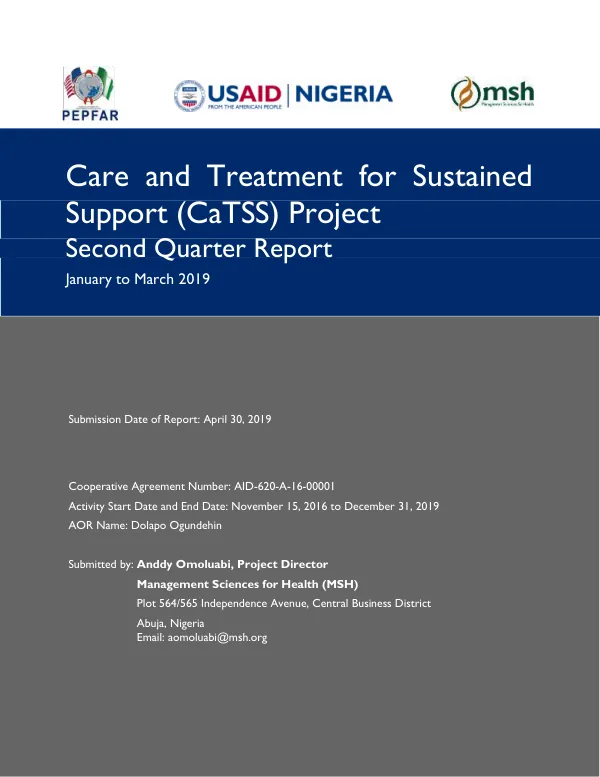
CaTSS FY19 Second Quarter Report – January to March 2019
The Care and Treatment for Sustained Support (CaTSS) project is a USAID-funded initiative implemented by Management Sciences for Health (MSH) in five states of Nigeria: Kebbi, Kwara, Niger, Sokoto, and Zamfara.
2019 · 52 pages
Sign in to readA free account is required to download.
Abstract
The project aims to strategically support the maintenance and uninterrupted delivery of quality HIV/AIDS and TB care and treatment services, integrated into Nigeria's health system. CaTSS works in close collaboration with the Government of Nigeria at the national, state, and local levels to achieve this goal. The project's technical support is tailored to match the specific program gaps in the respective project states while maintaining the considerable progress to date. CaTSS is pursuing three results areas: sustained access to and utilization of HIV/AIDS and TB care and treatment services, increased host government capacity to plan, manage, coordinate, and lead HIV/AIDS programs at state and local government levels, and improved capacity of healthcare facilities to provide sustainable, integrated, quality HIV/AIDS and TB services. In addition to the three results areas, CaTSS is also pursuing cross-cutting project outcomes, including enhanced sustainability and ownership, increased integration of services, optimized service utilization, and enhanced visibility of CaTSS. To achieve these outcomes, MSH's implementation of CaTSS is based on four overarching strategies: partnership, differentiation, cost-effectiveness, and maintenance of quality services. The project has made significant progress in the first quarter of 2019, with a total estimated contract amount of $14,791,172.00 and obligations to date of $12,995,113.74. The accrued expenditures for the quarter were $880,637.07, and the estimated expenditures for the next quarter are $1,528,694.00. The project has also achieved several key milestones, including the completion of a midterm evaluation and the development of a sustainability plan. CaTSS works in close collaboration with the Government of Nigeria at the national, state, and local levels to achieve its goals. The project has established partnerships with state governments, local government areas, and healthcare facilities to ensure the sustainability and effectiveness of its initiatives. MSH has also employed skilled and experienced Nigerian professionals in all the project's technical positions to guarantee value for money and promote cost sharing in all activities. The project's results have been impressive, with significant increases in the number of people accessing HIV/AIDS and TB care and treatment services. The project has also improved the capacity of healthcare facilities to provide quality services, and has enhanced the sustainability and ownership of the services provided. Overall, CaTSS has made significant progress in achieving its goals and has the potential to make a lasting impact on the health outcomes of the populations in the target states. CaTSS has also implemented several interventions to improve the quality of care and treatment services provided. These interventions include the provision of training and technical assistance to healthcare workers, the development of guidelines and protocols for the management of HIV/AIDS and TB, and the implementation of quality improvement initiatives. The project has also established a system for monitoring and evaluating the quality of care and treatment services provided, and has developed a plan for sustaining the services provided after the project life span. The project's geographic coverage includes 44 local government areas and 107 facilities in the five project states. The project has also established partnerships with several organizations, including the Government of Nigeria, state governments, local government areas, and healthcare facilities. The project's budget for the first quarter of 2019 was $880,637.07, and the estimated budget for the next quarter is $1,528,694.00.
Related documents