USAID DEC
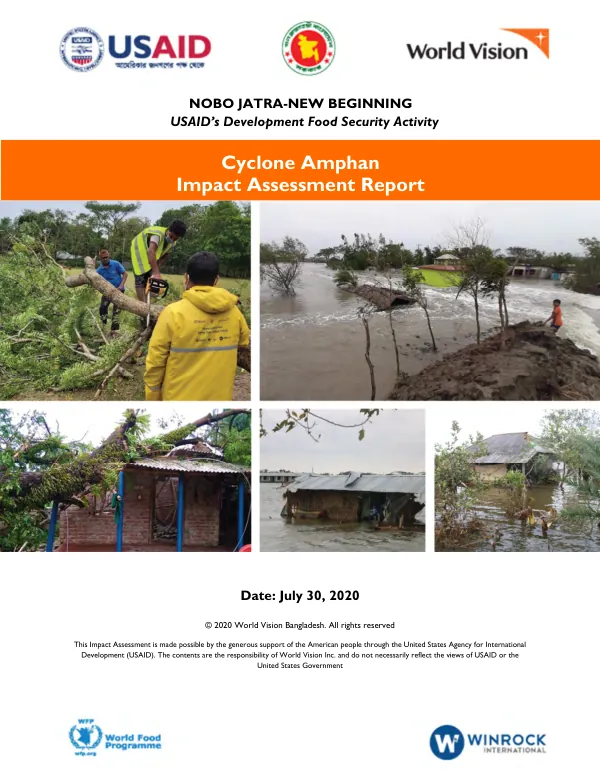
Nobo Jatra-NEW BEGINNING USAID’s Development Food Security Activity Impact Assessment Report
Sign inUSAID DEC
Nobo Jatra-NEW BEGINNING USAID’s Development Food Security Activity Impact Assessment Report
The cyclone Amphan impact assessment was conducted in 98 villages across 8 worst-affected unions in Koyra and Shyamnagar sub districts in southwest Bangladesh.
2020 · 9 pages
Sign in to readA free account is required to download.
Abstract
The assessment aimed to evaluate the impact of cyclone Amphan on Nobo Jatra's direct participant households, focusing on Water Sanitation and Hygiene, value chains, and Ultra Poor Graduation. The assessment found that household latrines in Koyra were worst affected by cyclone Amphan, with 265 (84%) of the 316 fully damaged latrines located in Koyra. A total of 1,048 (32.5%) latrines were partially damaged, with 754 (72%) of these located in Koyra. Damages to water points were also significant, with 86 (16.7%) of the 516 Nobo Jatra-supported water points fully damaged, affecting 5,100 direct participants who are not accessing safe water. Under Agriculture and Alternative Livelihoods programming, Nobo Jatra supports 4 value chains, including bottle gourd, bitter gourd, watermelon, and Genetically Improved Farmed Tilapia (GIFT) tilapia. The survey found that 16 producers had fully damaged homes, while 355 producers had partially damaged homes due to cyclone Amphan. Damages to bottle gourd value chain were significant, with 119 (63.9%) producers suffering partial losses and 24 (12.9%) suffering total loss of crops. Damages to bitter gourd value chain were also substantial, with 142 (79.7%) producers suffering partial losses and 10 (5.6%) suffering total loss of crops. The assessment also found that Ultra Poor Graduation participants were disproportionately affected by cyclone Amphan. Nobo Jatra targets 21,000 women through the Ultra Poor Graduation program, and the assessment found that 75% of community health service delivery points, including community clinics and Union Health and Family Welfare Centers, were not providing regular services such as Growth Monitoring and Promotion due to flooding. The assessment highlights the need for adaptation strategies and new activities to support the recovery of Nobo Jatra's direct participant households. The findings suggest that the cyclone Amphan has had a significant impact on the livelihoods and well-being of these households, and that urgent action is needed to address the challenges and gaps identified in the assessment. The assessment was conducted using a customized digital application under the Open Data Kit platform, with data collection taking place from June 28 to July 15, 2020. The sample included Nobo Jatra's direct participant households from the Water Sanitation and Hygiene, Agriculture and Alternative Livelihoods, and Ultra Poor Graduation components. The assessment was guided by the 'Do No Harm' principle and sought to ensure the safety and confidentiality of individuals and partners. The assessment found that 516 Nobo Jatra-supported water points were surveyed, with 86 (16.7%) fully damaged, affecting 5,100 direct participants. The assessment also found that 713 value chain producers were surveyed, with 16 producers having fully damaged homes and 355 producers having partially damaged homes. The assessment highlights the need for urgent action to address the challenges and gaps identified in the assessment and to support the recovery of Nobo Jatra's direct participant households.
Related documents
Documents in this collection
 2014
2014USAID DEC
Quantitative Impact Evaluation of the SHOUHARDO II Project in Bangladesh on Household Food and Livelihood Outcomes
Open record 2014
2014USAID DEC
Are Farmers Willing to Pay for Drought Tolerant Rice? Evidence From Bihar and Other Policy Research Priorities for Cereal Farming Systems in South Asia
Open record