USAID DEC
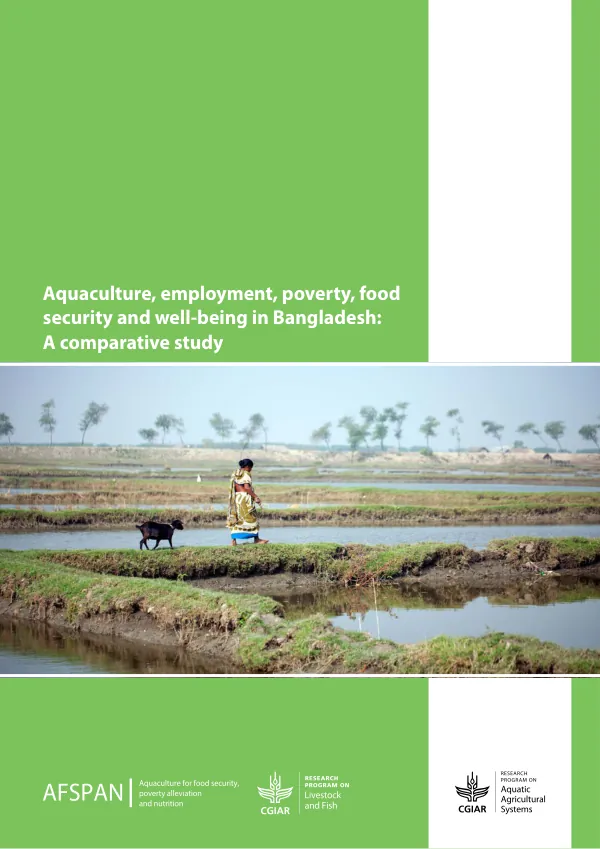
Aquaculture, employment, poverty, food security and well-being in Bangladesh: A comparative study
Sign inEUROPEAN UNION
Aquaculture, employment, poverty, food security and well-being in Bangladesh: A comparative study
The agricultural sector in Bangladesh has undergone significant changes in recent years, with aquaculture emerging as a major contributor to the country's food security and economic growth.
2014 · 72 pages
Sign in to readA free account is required to download.
Abstract
A comparative study conducted in six communities with contrasting patterns of aquaculture development aimed to investigate the relationships between aquaculture, employment, poverty, food security, and well-being. The study found that the wealthier a household, the higher the likelihood of its members practicing aquaculture as producers. However, participation of resource-poor households with limited landholdings in some forms of commercial aquaculture was much higher than anticipated. In fact, in certain villages, more small landowners and resource-poor farmers practiced commercial aquaculture than semisubsistence forms of aquaculture. The expansion of commercial aquaculture led to rapid and pervasive changes in land use and land tenure arrangements. Although the rise of commercial aquaculture was accompanied by a decline in the availability of land for paddy cultivation, sharecropping arrangements were replaced by dynamic rental markets that often facilitated access of small and medium producers to land. Employment opportunities in aquaculture were found to be inversely related to employment in agriculture. However, smallholder-dominated commercial aquaculture created more employment opportunities than it destroyed by smoothing seasonal demand for labor, often with employment conditions comparable or preferable to those in agriculture. In contrast, noncommercial aquaculture created very limited employment opportunities of any kind. The study also found that commercially oriented smallholder aquaculture producers consumed larger quantities of fish from their own farms than households operating subsistence-oriented fish production systems. On average, individuals from households practicing aquaculture consumed (and produced) more rice, fruits, nonleafy vegetables, and fish per capita than those that did not. The development of smallholder-dominated forms of commercial aquaculture was accompanied by increasing levels of women's engagement in related work. Women often lost access to and/or control over certain productive resources as part of this development process, but gained access to or control of others, resulting in ambiguous well-being outcomes. The emergence of commercial forms of aquaculture was accompanied by the "commodification of subsistence," a process by which producers become more deeply integrated into markets, and more dependent upon them for their means of survival. Nonmarket access to resources, particularly land and food, declined, with the result that some households became more vulnerable and increasingly dependent on selling their own labor. However, levels of material well-being often increased markedly for resource-poor households able to enter commercial aquaculture as producers. Smallholder-dominated commercial aquaculture development resulted in diverse social and economic transformations and a complex mix of well-being outcomes. Semisubsistence aquaculture created limited economic and social spillover effects. The risk of negative well-being outcomes resulting from development dominated by large-scale capitalist operations was high. In light of these findings, policies and interventions promoting aquaculture in Bangladesh should focus on supporting the development of smallholder-dominated aquaculture clusters, while fostering stronger local governance to regulate outcomes likely to impact well-being negatively.
Related documents