USAID. MISSION TO PHILIPPINES
Nonconventional energy development
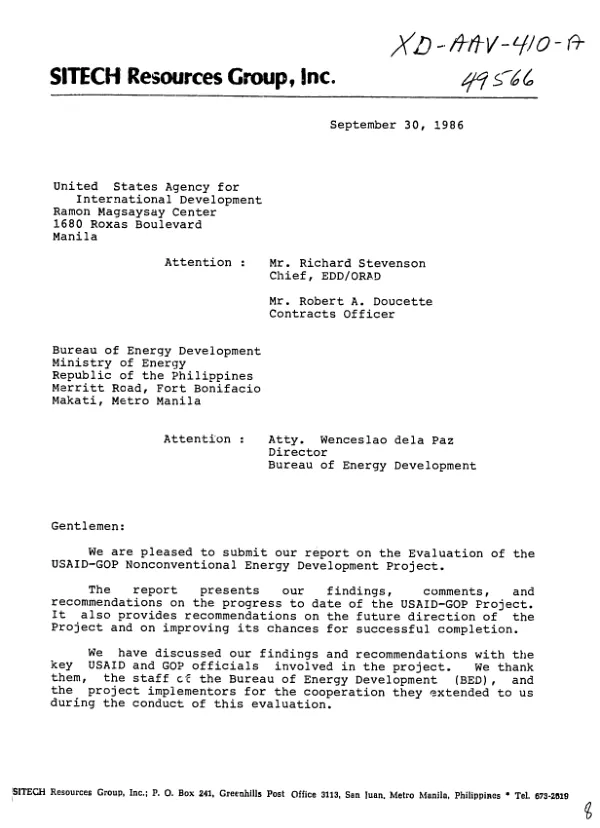
Summarizes an attached external evaluation (XD-AAV-410-A) of a project to demonstrate and transfer nonconventional energy technologies (NET"s) to rural areas of the Philippines.
1986
Sign in to readA free account is required to download.
Abstract
The evaluation covered the period 12/81-6/86 (6 months prior to the Project Assistance Completion Date - PACD) and was based on site visits, document review, and interviews. After a slow start in 1978 and a considerable revision of scope during the next 3 years, the project began making steady progress in 1982, following lines proposed in its first evaluation (12/81). The project consists of 26 subprojects, of which 16 are in the research, development, or demonstration of specific NET"s, and the remainder are project support activities such as training, information dissemination, and development of planning and technology evaluation methods. The project"s major achievement has been the formation and improvement of institutional staffs, notably in the Bureau of Energy Development (BED), where the project is conducted, but also in other public and private organizations. Although it is impossible to estimate the full impact of project technologies on the Philippines" eventual energy supply, nonconventional energy resources already contribute 17 million barrels of oil equivalent (BOE), or 18% of total energy consumption, and this number is expected to rise to 23 million BOE (20%) in 1990. Cogeneration is the largest single measure to reduce dependence on imported oil, although gasification technologies can also have important impacts on rural energy needs. The evaluation report recommends extensions of 6-12 months for SP"s in wind, integrated village energy systems, direct-heat gasification, cogeneration, graduate training, and financial planning. It also recommends additional training of BED staff in project planning and analysis, and the development of a long-term, commercially oriented gasification program. Action decisions are to: (1) extend the PACD with current funding for six subprojects to 9/87 to allow for their orderly completion; (2) realign the budget and develop a new implementation plan for the rest of the project; and (3) negotiate a local contract for project coordination. (Author abstract, modified)
Related documents