USAID DEC
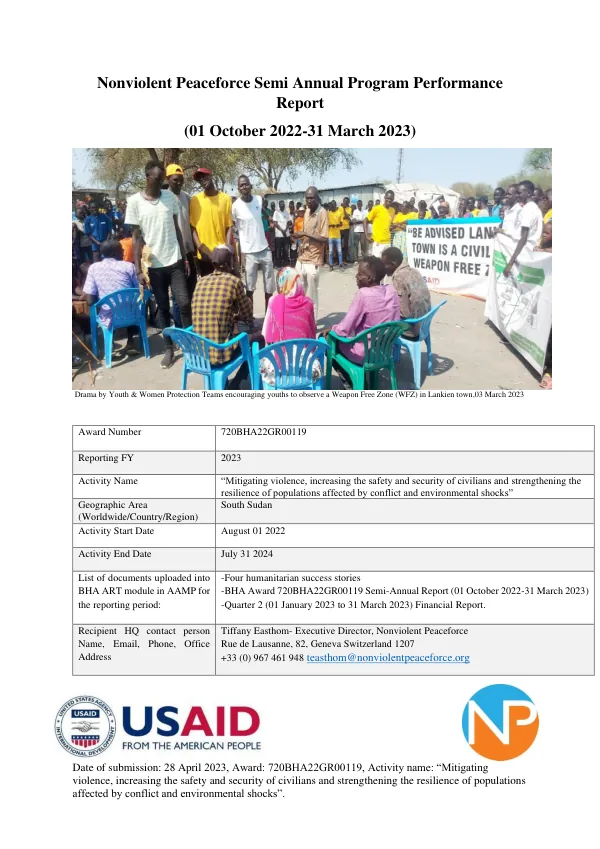
Nonviolent Peaceforce Semi Annual Program Performance Report (01 October 2022-31 March 2023)
Sign inINTERNATIONAL ORGANIZATION FOR MIGRATION
Nonviolent Peaceforce Semi Annual Program Performance Report (01 October 2022-31 March 2023)
Nonviolent Peaceforce is implementing a two-year project in South Sudan, funded by the Bureau of Humanitarian Assistance (BHA) for Award Number 720BHA22GR00119.
2023 · 13 pages
Sign in to readA free account is required to download.
Abstract
The project aims to mitigate violence, increase the safety and security of civilians, and strengthen the resilience of populations affected by conflict and environmental shocks. The project operates in Northern Jonglei, Warrap, Unity, Central Equatoria, and Greater Pibor Administrative Area. The project's three programmatic components focus on Child Protection (CP), Prevention and Response to Gender-based violence (GBV), and Protection Coordination, Advocacy, and Information. Nonviolent Peaceforce employs approaches entailed in the Unarmed Civilian Protection (UCP) methodology, including protective presence, relationship building, capacity building, monitoring, and advocacy. In the Greater Pibor Administrative Area, Nonviolent Peaceforce addressed numerous Child Protection concerns, particularly the return of abductees. Child protection trainings were held with Community Protection Team members, Block Leaders, female police, chiefs, and South Sudan People's Defense Forces (SSPDF). The trainings aimed to build the capacity of key community and government actors in the face of an increase in Child Protection concerns. In Lankien, Jonglei state, Nonviolent Peaceforce formed a Child Protection Committee (CPC) comprising 15 members, with an objective of enhancing the identification, prevention, and response to child protection cases within Lankien town. The CPC responded to child protection concerns, provided psychosocial first aid, and offered Child Safe Spaces to enlighten community members on CP activities and referral services. Nonviolent Peaceforce also conducted Family Tracing and Reunification (FTR) accompaniments for 15 cases of child abductions and 24 cases of GBV, in collaboration with local authorities, Women Protection Teams (WPTs), and health agency Médecins Sans Frontières (MSF). Under the Prevention and Response to GBV sub-sector, Nonviolent Peaceforce aims to increase the communities' ability to prevent and effectively respond to GBV incidents in all project sites. The organization conducted independent activities on the necessity of addressing Child Early Forced Marriage (CEFM) cases and accompaniment for rape/defilement cases in Lankien. Youth Protection Teams (YPTs) jointly collaborated with WPTs to form two groups that performed dramas to raise awareness about GBV and promote positive masculinities. Nonviolent Peaceforce also implemented a range of activities to address GBV, including addressing and informing community members about GBV, reducing stigmatization of survivors, highlighting and addressing key issues such as women's rights, and referral of support services. The organization worked in coordination with local authorities, WPTs, and health agencies to provide support services to GBV survivors. The project's overall performance is reflected in the progress achieved against each of the main project components. Nonviolent Peaceforce's protective presence, protective accompaniment, dialogue sessions, Early Warning and Early Response (EWER) sessions, and response to communities' protection needs through Community Protection Meetings (CPMs) contributed towards the overall project objective. The project's success is also reflected in the lessons learned and challenges encountered during the reporting period. Nonviolent Peaceforce addressed the beneficiary's protection concerns through Community Protection Teams (CPTs), which include Women Protection Teams (WPTs) and Youth Protection Teams (YPTs), that are instrumental in disseminating information to community members and mobilizing them for activities. The project's geographic focus is on South Sudan, with a specific emphasis on the regions of Northern Jonglei, Warrap, Unity, Central Equatoria, and Greater Pibor Administrative Area. The project's timeframes are from 01 August 2022 to 31 July 2024, with a grant amount of $3,600,000 amended in December 2022 to $7,500,000.