USAID DEC
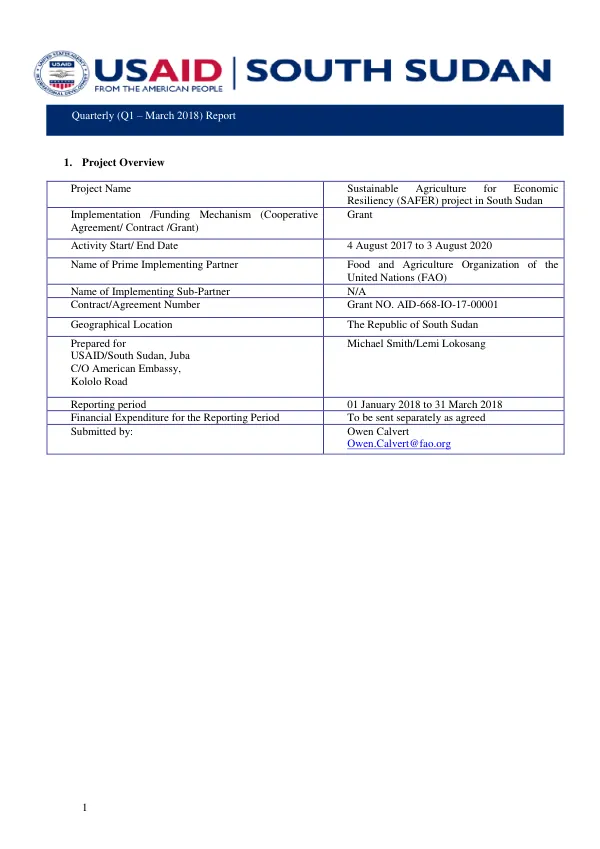
Quarterly (Q1 – March 2018) Report: Sustainable Agriculture for Economic Resiliency (SAFER) project in South Sudan
Sign inFOOD AND AGRICULTURE ORGANIZATION OF THE UNITED NATIONS IN GEORGIA
Quarterly (Q1 – March 2018) Report: Sustainable Agriculture for Economic Resiliency (SAFER) project in South Sudan
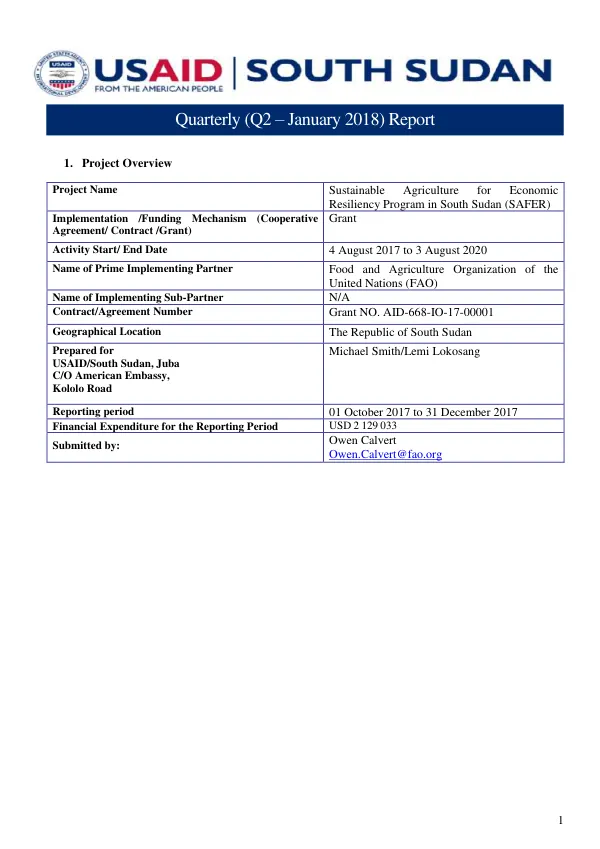
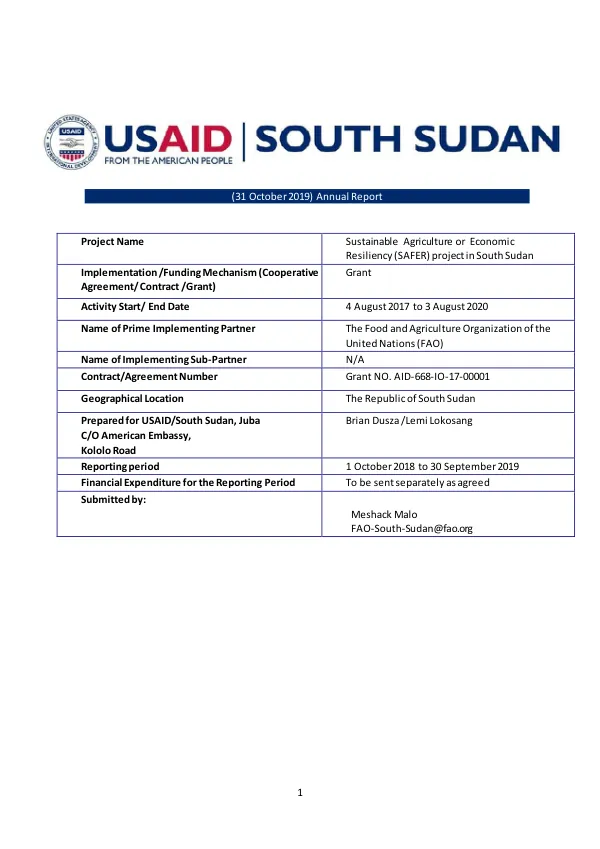
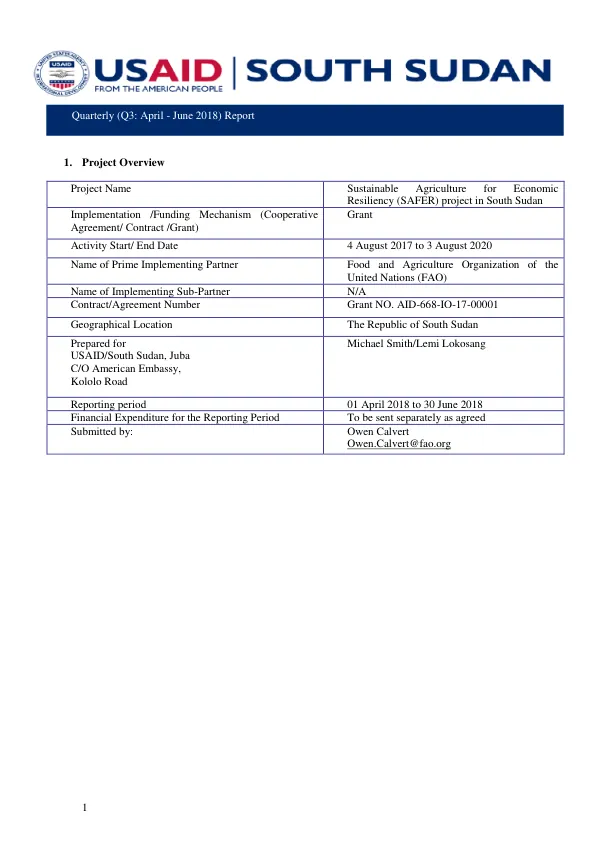
The Sustainable Agriculture for Economic Resiliency (SAFER) project in South Sudan began on August 4, 2017, and concluded on August 3, 2020.
2018 · 17 pages
Sign in to readA free account is required to download.
Abstract
The project was implemented by the Food and Agriculture Organization of the United Nations (FAO) with funding from the United States Agency for International Development (USAID) through a grant. The project's geographical focus was the Republic of South Sudan, with a primary objective of enhancing agricultural productivity and economic resilience among vulnerable communities. During the reporting period from January 1, 2018, to March 31, 2018, the project achieved several key milestones. Four inception workshops and stakeholder meetings were conducted, and two Letters of Agreement (LoAs) were signed with Service Providers (SPs). A fisheries assessment was conducted in Yambio, Western Equatoria State, and livestock and natural resource management assessments began in Rumbek, Lakes State. A high-level mission to Yambio was undertaken to support a joint project with several international organizations. Mapping of targets per cluster area was completed, and a revised baseline survey and monitoring and evaluation plan were submitted to USAID. The project also made significant progress in procurement and logistics, with the input procurement of crop and vegetable seeds, beekeeping items, agricultural tools, fishing equipment, and other essential inputs. These inputs were prepositioned to field hubs, ensuring timely delivery for the agricultural season. However, the project faced several challenges, including difficulties in negotiations with Ministries, late signing of LoAs with SPs, high expectations from downstream partners, and early rains. Despite these challenges, the project did not have any major recommendations at this early stage in implementation. The action plan for the next quarter (April 2018 to June 2018) focused on finalizing the signing of LoAs, training SPs, and completing necessary assessments. The project's progress was closely monitored, and a revised workplan and monitoring and evaluation plan were submitted to USAID in February 2018. The project's geographic focus was the Republic of South Sudan, with a primary objective of enhancing agricultural productivity and economic resilience among vulnerable communities. The project's implementation was closely coordinated with local authorities, international organizations, and other stakeholders to ensure effective delivery of project activities. The project's progress was regularly reported to USAID, and a quarterly report was submitted to provide an update on project achievements, challenges, and future plans. The project's implementation was guided by a revised workplan and monitoring and evaluation plan, which were submitted to USAID in February 2018. The project's progress was closely monitored, and a revised baseline survey report was submitted to USAID. The project's geographic focus was the Republic of South Sudan, with a primary objective of enhancing agricultural productivity and economic resilience among vulnerable communities. The project's implementation was closely coordinated with local authorities, international organizations, and other stakeholders to ensure effective delivery of project activities. The project's progress was regularly reported to USAID, and a quarterly report was submitted to provide an update on project achievements, challenges, and future plans. The project's action plan for the next quarter focused on finalizing the signing of LoAs, training SPs, and completing necessary assessments.
Related documents