USAID DEC
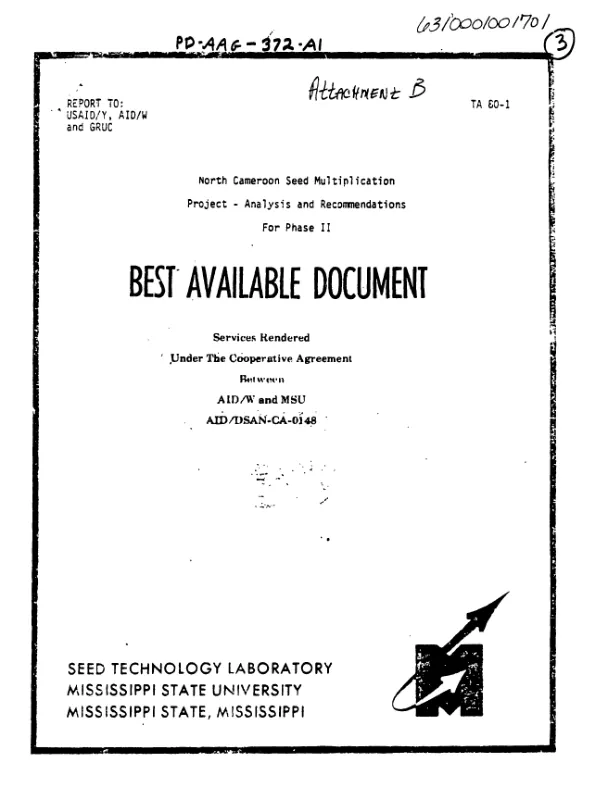
NORTH CAMEROON SEED MULTIPLICATION PROJECT - ANALYSIS AND RECOMMENDATIONS FOR PHASE II
Sign inUSAID. MISSION TO CAMEROON
NORTH CAMEROON SEED MULTIPLICATION PROJECT - ANALYSIS AND RECOMMENDATIONS FOR PHASE II
Evaluates project to assist the Government of Cameroon's Mission for the Development of Food Crops (MIDEVIV) to implement a seed multiplication and distribution program to meet the needs of 250,000 farmers.
REUSCHE, GARY A.|BECK, JAMES M.|VAUGHAN, CHARLES E. · 1980
Sign in to readA free account is required to download.
Abstract
This special evaluation covers the period 1/1/76-2/1/80 and is based on an onsite visit and a 3-day training seminar on seed technology. Major problems have included a lack of foundation seed, inadequate working conditions and excessive use of labor, adverse weather conditions, poor cultural techniques, and inadequate use of fertilizers and pesticides. In addition, the inclusion of three broad components -- seed production, dissemination, and marketing -- proved to be a basic error in the project design. Initially, the project was to be implemented over 5 years. However, funds are exhausted, and A.I.D. has reduced the life of the project by 1 year. The departure of U.S. personnel may lead to further problems. For example, the weeding, harvesting, and processing equipment has not yet arrived, and the seed warehouses are still under construction. This project should be considered an experiment which will set the foundation for Phase II of the project, establishment of a national seed service. A plan of action should be outlined for the transition period, and the government should be kept informed of modifications to the initial agreement. Furthermore, the Government of Cameroon and donor agencies should make every effort not to lose momentum during that time. Other recommendations include: (1) scaling the project to available manpower resources and emphasizing personnel training; (2) restricting seed production to two state-operated farms; (3) increasing support to those farms rather than dispersing project resources; (4) establishing a realistic time frame for the project; (5) providing technical expertise to organizations receiving foundation seed; and (6) educating farmers on the benefits of good seed. The authors emphasize that seed production at the small-farm level (a major activity during this evaluation period) should cease, and efforts should be redirected to information dissemination.
Related documents