USAID DEC
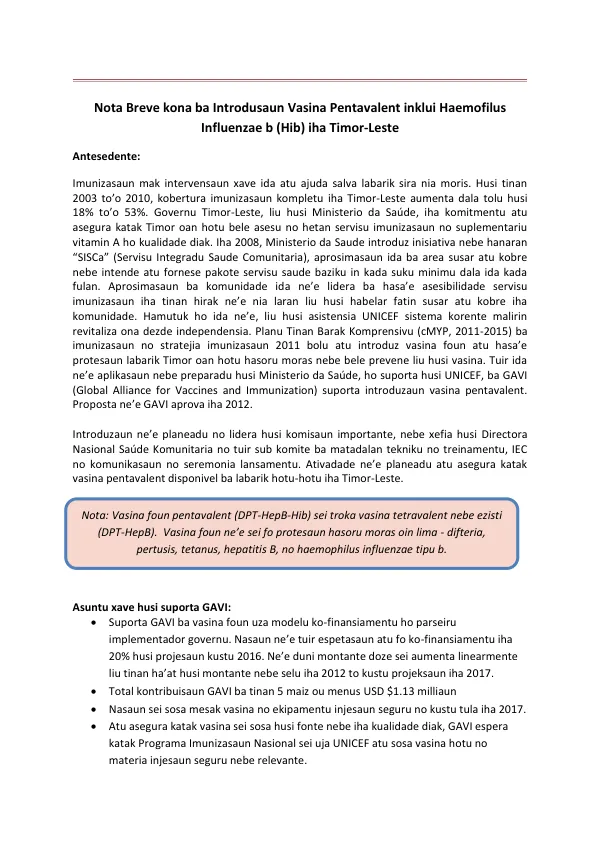
Nota Breve kona ba Introdusaun Vasina Pentavalent inklui Haemofilus Influenzae b (Hib) iha Timor-Leste
Sign inMINISTÉRIO DE SAÚDE
Nota Breve kona ba Introdusaun Vasina Pentavalent inklui Haemofilus Influenzae b (Hib) iha Timor-Leste
The introduction of the Pentavalent Vaccine in Timor-Leste was a significant step towards improving the health and well-being of children.
2012 · 3 pages
Sign in to readA free account is required to download.
Abstract
The vaccine, which includes Haemophilus influenzae type b (Hib), was introduced as part of the country's efforts to reduce the incidence of pneumonia and meningitis among children. The vaccine was made available through the Expanded Programme on Immunization (EPI) and was designed to provide protection against five diseases: diphtheria, pertussis, tetanus, hepatitis B, and Haemophilus influenzae type b. The Pentavalent Vaccine was introduced in Timor-Leste in 2012, following a commitment from the government to ensure that all children have access to quality immunization services. The vaccine was made available through a partnership between the Ministry of Health, UNICEF, and the Global Alliance for Vaccines and Immunization (GAVI). The introduction of the vaccine was a key component of the country's plan to reduce the incidence of pneumonia and meningitis among children. The Pentavalent Vaccine is a liquid vaccine that contains five antigens: DPT, HepB, and Hib. It is designed to provide protection against five diseases and is available in a presentation of 10 doses. The vaccine must be stored at a temperature of 2-80C and must be transported in an ice pack to prevent it from spoiling. The vaccine must be shaken before use and must be discarded if it has been spoiled. The recommended schedule for the Pentavalent Vaccine is three doses, given at 6, 10, and 14 weeks of age. The first dose is given at 6 weeks of age, followed by the second and third doses at 10 and 14 weeks of age, respectively. The vaccine is given intramuscularly in the left thigh. The Pentavalent Vaccine has been shown to be safe and effective in preventing pneumonia and meningitis among children. However, as with any vaccine, there may be some side effects, such as redness, swelling, and pain at the injection site. These side effects are usually mild and temporary, but in some cases, they may be more severe.
Related documents