USAID DEC
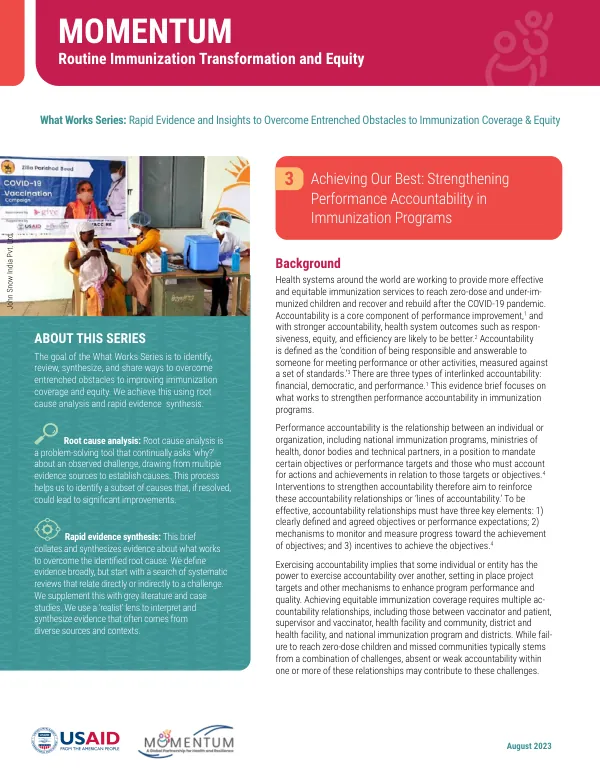
What Works Series: Rapid Evidence and Insights to Overcome Entrenched Obstacles to Immunization Coverage & Equity
Sign inUSAID DEC
What Works Series: Rapid Evidence and Insights to Overcome Entrenched Obstacles to Immunization Coverage & Equity
Health systems worldwide are working to provide more effective and equitable immunization services to reach zero-dose and under-immunized children and recover and rebuild after the COVID-19 pandemic.
2023 · 8 pages
Sign in to readA free account is required to download.
Abstract
Accountability is a core component of performance improvement, and with stronger accountability, health system outcomes such as responsiveness, equity, and efficiency are likely to be better. Accountability is defined as the condition of being responsible and answerable to someone for meeting performance or other activities, measured against a set of standards. There are three types of interlinked accountability: financial, democratic, and performance. Performance accountability is the relationship between an individual or organization, including national immunization programs, ministries of health, donor bodies, and technical partners, in a position to mandate certain objectives or performance targets and those who must account for actions and achievements in relation to those targets or objectives. Interventions to strengthen accountability aim to reinforce these accountability relationships or lines of accountability. To be effective, accountability relationships must have three key elements: clearly defined and agreed objectives or performance expectations, mechanisms to monitor and measure progress toward the achievement of objectives, and incentives to achieve the objectives. Exercising accountability implies that some individual or entity has the power to exercise accountability over another, setting in place project targets and other mechanisms to enhance program performance and quality. Achieving equitable immunization coverage requires multiple accountability relationships, including those between vaccinator and patient, supervisor and vaccinator, health facility and community, district and health facility, and national immunization program and districts. The What Works Series aims to identify, review, synthesize, and share ways to overcome entrenched obstacles to improving immunization coverage and equity. This series uses root cause analysis and rapid evidence synthesis to achieve its goal. Root cause analysis is a problem-solving tool that continually asks "why?" about an observed challenge, drawing from multiple evidence sources to establish causes. Rapid evidence synthesis collates and synthesizes evidence about what works to overcome the identified root cause. The review focuses on performance accountability at sub-national levels of the health system. Weak or absent accountability could be characterized by a lack of shared understanding of the roles and responsibilities of program staff, and a lack of consequences for those responsible for poor performance or when those responsible take no ownership of these results. On the other hand, the presence of strong and clear lines of accountability, accompanied by sufficient autonomy and empowerment, can encourage those accountable to reach performance targets or objectives. National and sub-national immunization professionals should identify the accountability relationships required to increase immunization coverage of zero-dose children and missed communities and understand the barriers to accountability. They should define accountability benchmarks and create a process for institutionalizing those benchmarks through regular performance review meetings at the national and subnational levels. An accountability framework should be designed to include a holistic package of interventions based on local needs with considerations for upward and downward accountability. Mechanisms that reinforce accountability relationships should be implemented, including clarifying performance expectations, increasing motivation, and incentivizing strong performance. Interventions that can reinforce accountability relationships include supportive supervision, group problem solving, performance review meetings, financial incentives, regular performance monitoring and measuring, and social accountability approaches such as health facility committees and citizen report cards.
Related documents