THE KAIZEN COMPANY
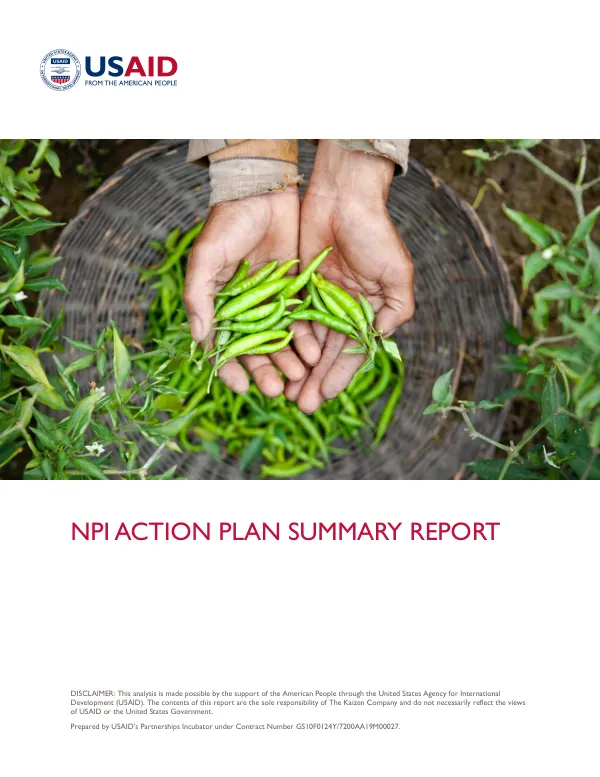
NPI Action Plan Summary Report
The New Partnerships Initiative (NPI) is USAID's flagship initiative as part of the Agency's Acquisition and Assistance (A&A) Strategy.
2021 · 35 pages
Sign in to readA free account is required to download.
Abstract
NPI Action Plans are strategic, operational documents that USAID Missions and overseas Operating Units use to describe how they plan to expand their use of NPI's three partnership approaches. These approaches are critical to diversifying the Agency's base of implementers, expanding engagement with local partners, and working with traditional partners in new ways to build local capacity and move toward greater local ownership and sustainability. Missions and OUs were required to include activities that use any of the following partnership approaches: direct awards to new and underutilized partners (NUPs), including local entities, locally established partners, and non-local organizations; mentoring awards to organizations that sub-award more than 50 percent of the total award value; and leverage awards to organizations that co-fund with cash. Missions and OUs also were required to describe their use of co-creation and enhanced local capacity development, which are NPI standard practices. The NPI Action Plans reveal that more than two-thirds of Missions see NPI as a continuation or expansion of ongoing efforts to engage with new and underutilized partners, especially local partners. This understanding provides a strong foundation on which the Agency can continue to expand local partnerships, work with traditional partners to strengthen local capacity, and move toward greater local ownership and sustainability of development solutions. NPI Partnerships Approaches include direct awards to new and underutilized partners, mentoring awards to traditional partners who then sub-award most of their funding to NUPs, and leverage awards. Missions most favor direct awards to local entities, and mentoring awards are the approach with the largest average total estimated cost (TEC). Overall, almost 90 percent of the Missions indicate a strong or moderate intention to use at least one of the two NPI standard practices – co-creation and enhanced capacity development – for future activities. Collectively, Missions and Operating Units around the world identified 1,069 NPI activities that would be implemented at some point during three fiscal years (FYs 2019–2021) with a cumulative TEC of $13 billion. The Agency will implement more than 40 percent of these activities in the Africa region, with the next-largest activity numbers in the Asia region and in the Latin America and Caribbean region. According to the Action Plans, Missions consider the limited capacity of NUPs as the most significant barrier and risk to NPI implementation. NUPs may have limited knowledge of USAID systems, procedures, and requirements, or lack experience in achieving evidence-based development results. While the partners are usually already working, they may have operational gaps, such as inadequate financial management, or may lack human resources policies and procedures or procurement processes. Although Missions and OUs generally place less emphasis on local capacity development as a prioritized practice for their NPI activities than co-creation, 68 Missions initiated reporting of partner data on the Capacity Building and Local Development Indicator (CBLD-9) for FY 2021. Based on Mission FY 2020 reporting for this indicator, about 5,000 organizations working with Missions showed measured improvement in capacity. Two-thirds of Missions and OUs either explicitly state that no additional support is required for NPI implementation or do not mention any specific needs. The remaining one-third note constraints in three main categories. Some lack time or personnel to meet the increased management demands of working with NUPs or face budget limitations or cuts at the Mission. Some need more flexible procurement options. Few Missions suggested solutions to these challenges, although several did reference the Partnerships Incubator or other third-party contractors as options for addressing limited personnel capacity.
Related documents