FLORIDA INTERNATIONAL UNIVERSITY
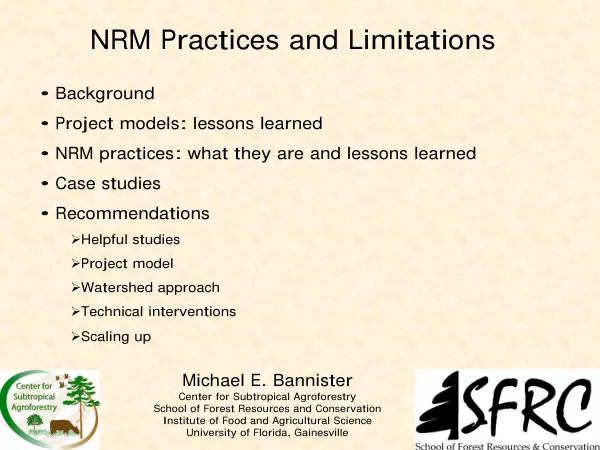
NRM Practices and Limitations
NRM Practices and Limitations in Haiti Haiti is a predominantly mountainous country with 60% of its population residing in rural areas.
2010 · 31 pages
Sign in to readA free account is required to download.
Abstract
Agriculture is a significant economic activity, but it is not the only domain of economic activity. Farms in Haiti are small and complex, with an average total area of 1.7 hectares and 3 to 4 plots. Land is held under various modes of access, with approximately 75% being owned by farmers. Plots are located in different ecological zones, and farmers are market-directed rather than subsistence-directed. Long-term intensive hillside agriculture is not a viable future option for Haiti due to its degraded resource base, high costs, and risks. Farmers will always want to engage in some annual cropping, and the population is increasing while plot size is decreasing. Acute poverty is a significant issue, with 82% of the rural population living below $2 per day. Rural families have multiple objectives, and their primary focus is on improving their economic situation. Short and medium-term lessons learned from NRM projects in Haiti can be applied to address these challenges. Watershed-based projects have shown promise in speeding up landscape restoration, restoring ecosystem function, mitigating poverty, and slowing anarchic growth in cities. Some old project models have had successes, and there appears to be a convergence of development ideas. Market forces can lead development, but other support is also needed. Animals and tree crops are the most important on-farm revenue sources. Project models in Haiti have varied, including Équipement du territoire, Jobs creation civic infrastructure, plot-based, watershed-based, cross-border, new mutual-interest coalitions, participatory local community development, and mixed models. Lessons learned from these projects include the importance of building long-term relationships, working through local NGOs, CBOs, and work groups, and incorporating input from farmers and field staff. A mixed project model is often necessary to maximize coverage in a watershed, and regional infrastructure projects using paid rural labor should consider how other on-farm projects operate. Social scientists working with technicians is an effective approach. NRM practices in Haiti have included linear structures such as rock walls, hedgerows, Bann manje, and tram. Economics drives technology evolution, and farmers have adapted these structures in response to market demands. For example, Leucaena hedgerows were protected by adjacent rows of cassava, while cotton hedgerows were established in response to the Saut d'Eau lantern market. Bann manje evolved from hedgerows in response to markets for high-value perennials. Soil conservation and ravine control have also been addressed through hardwood tree planting, which is a common practice among farmers. Trees are a store of value, and tree tenure can be separate from land tenure.