WORLD LEARNING, INC.
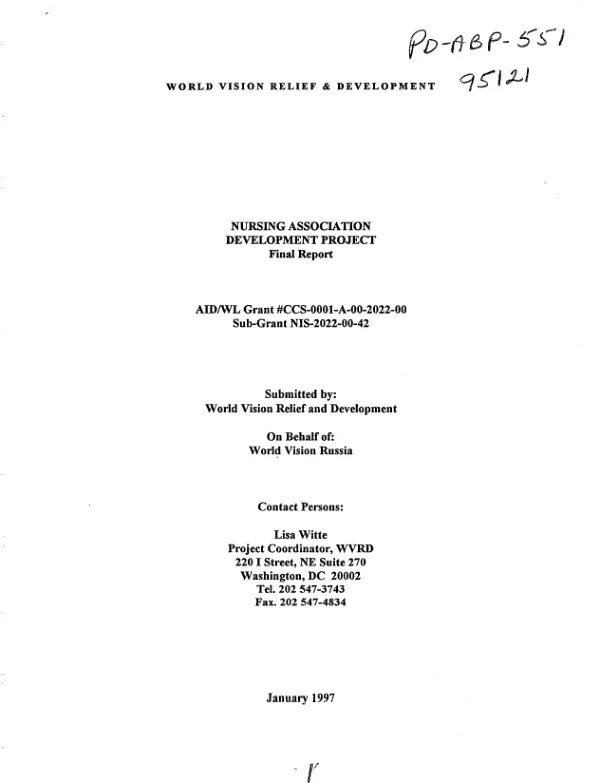
Nursing association development project : final report
Final report of the contractor, World Vision Relief and Development, Inc., on a project (10/94-11/96) to strengthen the organizational and managerial development of two nursing associations in Russia -- the Chita Nursing Association, located in Siberia, and the Ekaterinburg Nurses" Association, located in a highly industrialized region of the Ural Mountains.
1997
Sign in to readA free account is required to download.
Abstract
Potential direct beneficiaries include the educators and nursing students of the 11 nursing colleges in the Ekaterinburg region and of the 9 local nursing colleges in the Russian Far East. The stated goals and objectives were met. The nurses" associations in both regions are functioning more efficiently than before the project began. Both have presidents, boards, mission statements, strategic and financial plans, and a fairly significant membership base. Nursing standards have been written for a variety of areas, tailored to the specific settings and sites. Demonstration units were set up to illustrate the practical application of standards in the work site, and have become a primary training tool. The associations used nursing conferences to disseminate their work on standards and demonstration units to larger audiences, and to recruit new members. A survey to specify preferred midwife behaviors was completed and has been discussed at city and oblast levels; positive changes in midwifery practice have already occurred as a result. In addition, the nurses" associations plan to use the results to develop new surveys to study and improve existing practices, and to offer additional training to patients, families, and midwives. The distance between the project"s two sites was the chief constraint to implementation. In retrospect, it would have been more effective to focus on one site. Other lessons learned are as follows. (1) Two years was not enough time to establish the professional credibility of the nurse educators with the Russian chief nurses and educators, who were generally in their mid- to late forties. (2) When a project aims to develop technical and professional organizations, project leadership and direction is best provided by individuals of that profession. (3) Advanced planning and allocation of resources for necessary professional and technical materials is essential in a country lacking such resources. (4) It is neither wise nor possible to impose Western standards on Russian culture. It is better to have the Russian partners identify their own needs before offering ideas of one"s own. The mere presence of a "development" project that gives the message that the Russian way is flawed is an affront to national pride. (5) Build relationships with key ministry and department of health leaders at the inception of the project. Although the grant directly targeted professional associations, in Russia it is still necessary to work through governmental channels. (6) Sensitivity to the differences in cultures and practices must be integral to the work being done. This includes setting timelines and objectives that fit the local mindset and work ethic. In this regard, grant objectives were overly ambitious at best.
Related documents
Documents in this collection
 1997
1997USAID DEC
Final project report : Novosibirsk Disabled Community Health Clinic -- cooperative program by medical professionals and disabled consumers : grant no. NIS-2022-00-46
Open record 1996
1996USAID DEC