USAID DEC
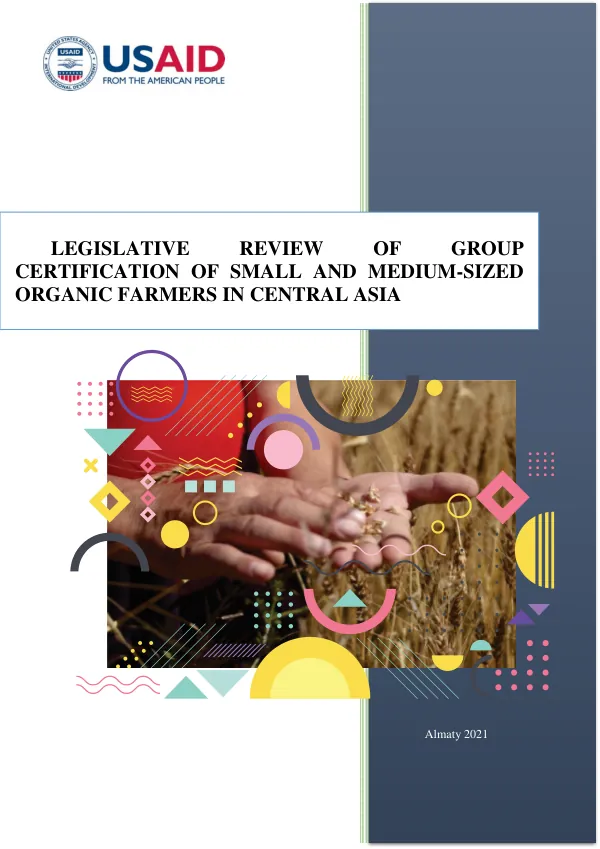
LEGISLATIVE REVIEW OF GROUP CERTIFICATION OF SMALL AND MEDIUM-SIZED ORGANIC FARMERS IN CENTRAL ASIA
Sign inEUROPEAN UNION
LEGISLATIVE REVIEW OF GROUP CERTIFICATION OF SMALL AND MEDIUM-SIZED ORGANIC FARMERS IN CENTRAL ASIA
The regulatory and legal framework of organic production in Central Asia has undergone significant evolution.
2021 · 45 pages
Sign in to readA free account is required to download.
Abstract
Organic agriculture is a clearly defined approach to agricultural production, originating from private standards established by farmers themselves. The establishment of the main principles of organic agriculture was a response to the negative aspects of conventional industrialized intensive agriculture. As a result, the ideas of organic production began to disseminate around the world since the mid-1980s as an alternative to the widespread introduction of synthetic mineral fertilizers and pesticides in agricultural practice. The International Organization of Organic Agriculture Movements (IFOAM), founded in 1972, developed the first harmonized international rules, Basic Standards, in 1983. These Basic Standards defined the minimum requirements of organic agriculture and laid the foundation for writing more detailed standards. The European Union (EU) has also played a significant role in the development of organic production standards, with the first related national legislation introduced in France in 1980, followed by Austria in 1983 and Denmark in 1987. In Central Asia, organic agriculture has begun to actively develop, with a focus on export-oriented agricultural raw materials. However, the region also has a high potential for internal market development, with small-scale farmers in Kyrgyzstan successfully participating in initiatives. The potential capacity of the internal market in Kazakhstan is estimated to be over KZT 100 billion, with small and medium-sized producers being the main players in the internal organic market. The certification procedure for organic production is currently inaccessible to small and medium-sized producers due to its high cost. To address this issue, the introduction of producers' group certification at the national level on the basis of the Internal Control System (ICS) and the Participatory Guarantee System (PGS) is proposed. This review aims to study the regulatory and legal framework of Central Asian countries to assess the possibility of introducing small producers' group certification, identify existing barriers in the legislation, and develop recommendations on how to eliminate these barriers. The International Federation of Organic Agriculture Movements (IFOAM) and the FiBL Research Institute of Organic Agriculture report that the world's organic land area exceeded 70 million hectares in 2019, a significant increase from 1999. This growth in organic agriculture has led to the development of various standards and certification systems, including the Codex Alimentarius, the International Organization for Standardization (ISO), and the IFOAM Norms. The Codex Alimentarius is an international food safety standard that includes guidelines for organic production. The ISO has developed standards for organic production, including the requirement for bodies certifying products, processes, and services. The IFOAM Norms provide a framework for organic production, including the principles of organic agriculture, the requirements for organic production, and the guidelines for certification. In Central Asia, the regulatory and legal framework for organic production varies across countries. Kazakhstan, Kyrgyzstan, Tajikistan, Turkmenistan, and Uzbekistan have their own organic production legislation, which is discussed in the review. The review also provides recommendations for statutory regulation of Participatory Guarantee Systems (PGS) and the creation of Internal Control Systems (ICS) to facilitate the certification of small and medium-sized producers.
Related documents