INDONESIAN MINISTRY OF RESEARCH, TECHNOLOGY, AND HIGHER EDUCATION
Nutrition Coordination Structure for Tanzania (2023)
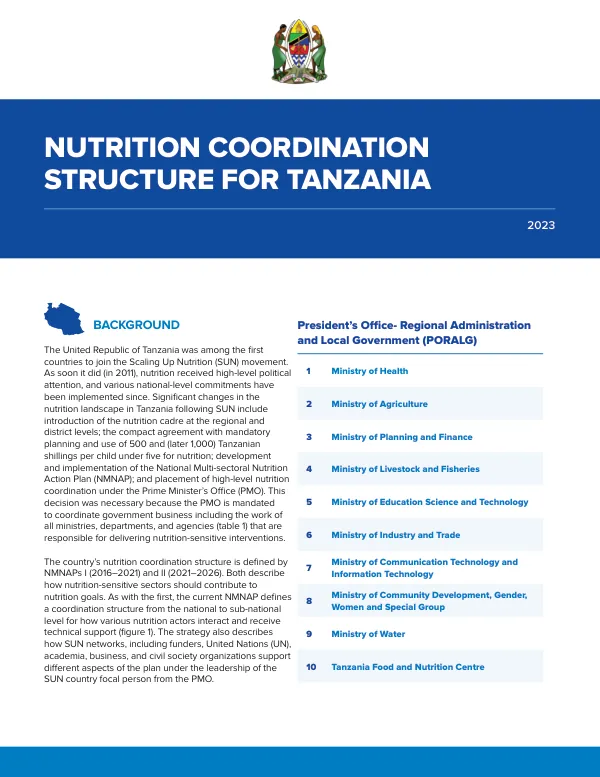
The United Republic of Tanzania has a well-established structure for nutrition coordination, which was initiated in 2011 when the country joined the Scaling Up Nutrition (SUN) movement.
2023 · 3 pages
Sign in to readA free account is required to download.
Abstract
This move led to high-level political commitment and the implementation of various national-level initiatives. The introduction of the nutrition cadre at the regional and district levels, the compact with mandatory planning and use of 500 and later 1,000 Tanzanian shillings per child under five for nutrition, and the development and implementation of the National Multi-sectoral Action Plan (NMALP) are significant changes in the nutrition landscape in Tanzania. The National Multi-sectoral Action Plan (NMALP) defines the country's nutrition coordination structure, which is defined by NMALP I (2016-2021) and NMALP II (2021-2026). Both plans describe how various sectors should contribute to nutrition goals. The current NMALP defines a coordination structure from the national to sub-national level for how various actors interact and receive support. SUN networks, including funders, the United Nations, academia, business, and civil society organizations, support different aspects of the plan under the leadership of the SUN country focal person from the Prime Minister's Office (PMO). The High-Level Steering Committee for Nutrition (HLSCN) is a key component of the nutrition coordination structure. It consists of permanent secretaries from all nutrition-sensitive sectors and meets biannually to discuss NMALP implementation progress and sector plans before presentation to parliament. The meeting is chaired by the permanent secretary from the PMO, and the managing director from the Tanzania Food and Nutrition Center serves as the secretary. SUN network leaders are also represented. The Multi-sectoral Nutrition Technical Group comprises direct representatives from nutrition-sensitive sectors and meets biannually to escalate various issues to the HLSCN. It is chaired by the SUN focal person from the PMO and hosted before the HLSCN. The thematic working groups (TWGs) focus on nutrition governance, promotion, services delivery, and sensitivity. They meet quarterly to discuss NMALP implementation progress and are chaired by technical directors from thematic sectors and co-chaired by representatives from implementing partners. The PMO ensures that sectors have planned, budgeted, and implemented nutrition-sensitive and other activities that will create an enabling environment for nutrition. It also ensures adequate resource allocation for planned activities. The PMO's coordination office reports gaps and unmet needs to the PMO for decision-making and action. The office also strengthens partner linkages by linking new nutrition partners with respective sector ministries and the President's Office, Regional Administration, and Local Government (PORALG). The PMO's coordination office ensures accountability for nutrition by requiring each partner to fulfill its expectations. It also facilitates smooth communication and resource allocation between government, implementing partners, the United Nations, and private sector actors. Each group reports its accomplishments annually and outlines plans for the next year. Tanzania is a member of various global and regional nutrition initiatives, including Nutrition for Growth, SUN, the Southern African Development Cooperation, and the African Union. The PMO's coordination office ensures swift response and representation at these initiatives.