POWER AFRICA
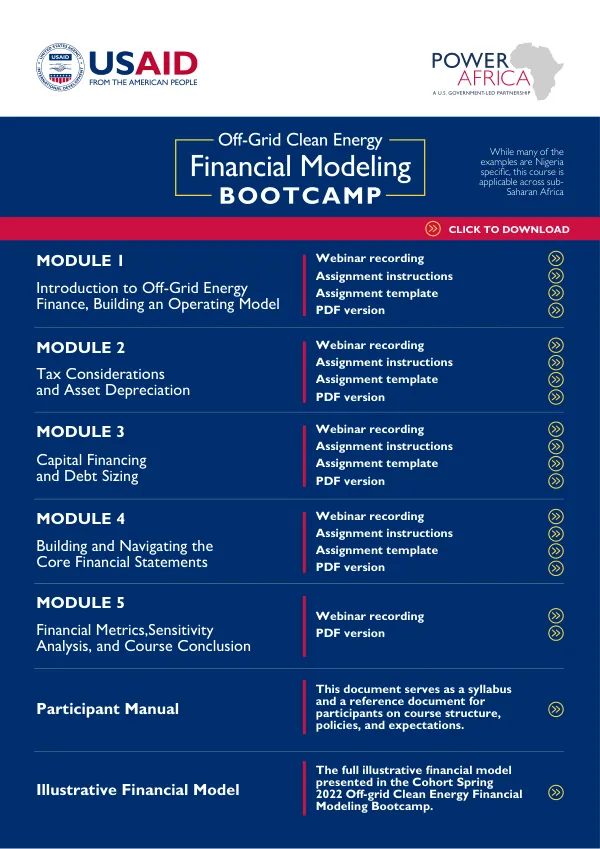
Off-Grid Clean Energy Financial Modeling BOOTCAMP
Off-grid energy finance is a critical component in the development of sustainable energy solutions in sub-Saharan Africa.
1 pages
Sign in to readA free account is required to download.
Abstract
The region's vast rural areas often lack access to reliable and affordable energy, hindering economic growth and poverty reduction. To address this challenge, a comprehensive approach to off-grid energy finance is necessary, encompassing various aspects including financial modeling, tax considerations, and capital management. The financial model for off-grid energy projects in sub-Saharan Africa typically involves a combination of grants, debt, and equity financing. Grants are often provided by international organizations and governments to support the development of off-grid energy infrastructure. Debt financing, on the other hand, is typically sourced from commercial banks and specialized financial institutions. Equity financing, which involves the injection of capital by investors, is also a crucial component of off-grid energy finance in the region. Tax considerations play a significant role in off-grid energy finance, particularly in sub-Saharan Africa where tax regimes can be complex and often complex. Asset depreciation is a key tax consideration, as it allows businesses to recover the cost of assets over their useful life. In the context of off-grid energy projects, asset depreciation can be depreciated over a period of 5-10 years, depending on the type of asset and the applicable tax laws. Capital management is another critical aspect of off-grid energy finance in sub-Saharan Africa. The region's off-grid energy market is characterized by high levels of risk, including currency risk, currency fluctuations, and project execution risk. To mitigate these risks, businesses must develop robust capital management strategies, including cash flow management, risk management, and asset allocation. A well-managed capital structure is essential for the long-term sustainability of off-grid energy projects in the region. The core financial statements, including the balance sheet, income statement, and cash flow statement, provide a comprehensive picture of a business's financial performance. In the context of off-grid energy finance, these statements are critical for evaluating the financial health of a project and making informed investment decisions. Sensitivity analysis, which involves analyzing the impact of changes in key variables on a project's financial performance, is also an essential tool for off-grid energy finance professionals in the region. The illustrative financial model presented in the Cohort Spring 2022 Off-grid Clean Energy Financial Modeling Bootcamp provides a comprehensive framework for analyzing off-grid energy projects in sub-Saharan Africa. The model includes a detailed financial analysis of a sample project, including cash flow projections, sensitivity analysis, and a comprehensive financial statement analysis. This model serves as a valuable resource for off-grid energy finance professionals in the region, providing a practical guide to financial modeling and analysis.