USAID DEC
Oil palm monoculture is not a suitable environment for most forest specialist species of Odonata in Amazonia
Sign inUSAID DEC
Oil palm monoculture is not a suitable environment for most forest specialist species of Odonata in Amazonia
Oil palm plantations have become the most rapidly increasing large-scale crop in Amazonia due to favorable environmental conditions and incentives from executives and governing authorities.
2018 · 1 pages
Sign in to readA free account is required to download.
Abstract
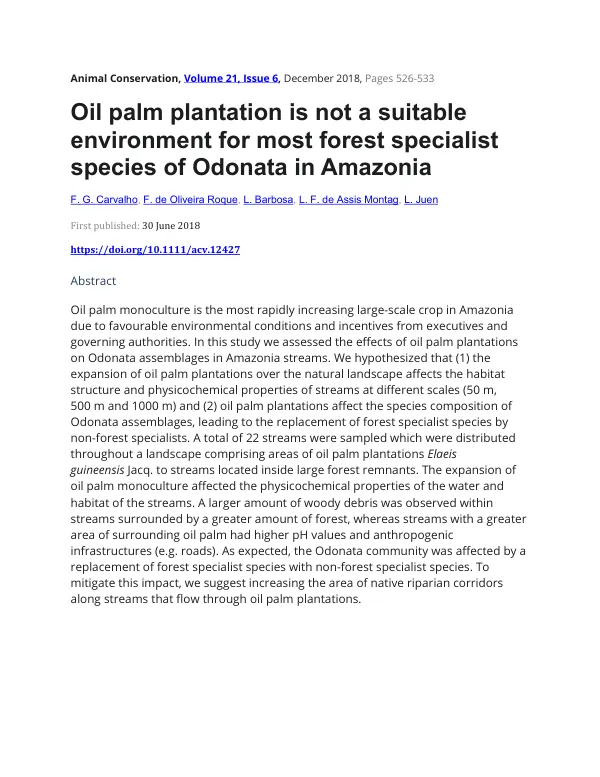
The expansion of oil palm plantations over the landscape affects the habitat and physicochemical properties of streams at different scales. This includes changes to the water and habitat of streams, with a larger amount of woody debris observed in streams surrounded by a greater amount of forest. In contrast, streams with a larger area of surrounding oil palm plantations have higher pH values and more frequent presence of roads. The Odonata assemblage, a group of dragonflies and damselflies, is affected by the expansion of oil palm plantations. A total of 22 streams were sampled, distributed throughout a landscape comprising areas of oil palm plantations and large forest remnants. The results show that the expansion of oil palm monoculture leads to the replacement of forest specialist species with non-forest specialist species. This replacement is observed in the Odonata assemblage, with forest specialist species being less abundant in streams surrounded by oil palm plantations. The physicochemical properties of the water and habitat of streams are altered by the expansion of oil palm plantations. Streams with a larger area of surrounding oil palm plantations have higher pH values and more frequent presence of roads. This suggests that the expansion of oil palm plantations has a significant impact on the environment, affecting the habitat and physicochemical properties of streams. The results of this study highlight the need for conservation efforts to mitigate the impact of oil palm plantations on the environment. The study suggests that increasing the area of native riparian corridors along streams that flow through oil palm plantations can help mitigate the impact of oil palm plantations on the environment. This approach can help maintain the habitat and physicochemical properties of streams, and reduce the replacement of forest specialist species with non-forest specialist species. By implementing conservation efforts, it is possible to reduce the negative impact of oil palm plantations on the environment and maintain the biodiversity of the Odonata assemblage. The results of this study have important implications for the conservation of the Odonata assemblage in Amazonia. The expansion of oil palm plantations has a significant impact on the environment, affecting the habitat and physicochemical properties of streams. The replacement of forest specialist species with non-forest specialist species is a major concern, as it can lead to a loss of biodiversity and ecosystem function. By implementing conservation efforts, it is possible to reduce the negative impact of oil palm plantations on the environment and maintain the biodiversity of the Odonata assemblage.
Related documents