USAID DEC
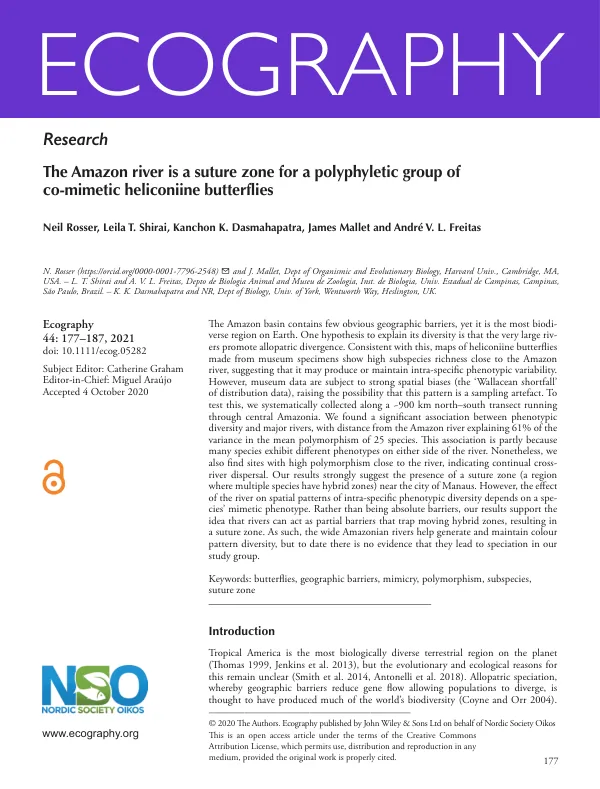
The Amazon river is a suture zone for a polyphyletic group of co-mimetic heliconiine butterflies
Sign inUSAID DEC
The Amazon river is a suture zone for a polyphyletic group of co-mimetic heliconiine butterflies
The Amazon basin contains few obvious geographic barriers, yet it is the most biodiverse region on Earth.
2021 · 11 pages
Sign in to readA free account is required to download.
Abstract
One hypothesis to explain its diversity is that the very large rivers promote allopatric speciation. Consistent with this, maps of heliconiine butterflies made from museum specimens show high subspecies richness near the Amazon river, suggesting that it may produce or maintains intra-specific phenotypic variability. However, museum data are subject to strong biases, raising the possibility that this pattern is a sampling artefact. To test this, a systematic collection of heliconiine butterflies was conducted along a ~900 km north-south transect running through the Amazon River. The study found a significant association between phenotypic diversity and the Amazon river, with distance from the river explaining 61% of the variance in the mean polymorphism of 25 species. This association is partly because many species exhibit different phenotypes on either side of the river. However, the study also found sites with high polymorphism close to the river, indicating continual cross-river dispersal. The results suggest the presence of a suture zone near the city of Manaus. However, the effect of the river on spatial patterns of intra-specific phenotypic diversity depends on the species' Minetic phenotype. Rather than being absolute barriers, the wide Amazonian rivers help generate and maintain colour pattern diversity. The study found that the Amazon river is a suture zone for a polyphyletic group of co-mimetic heliconiine butterflies. Heliconiines comprise about 70 species and 300 subspecies of brightly coloured neotropical butterflies known for their Müllerian mimicry. Maps of subspecies richness made from museum specimens exhibit a striking pattern, with high richness along the course of the Amazon river and its tributaries. This pattern is apparent even when the mean number of subspecies per species is mapped, thereby controlling for variation in species richness. In heliconiines, subspecies are defined as wing colour variants that are fixed in at least part of their geographic range. The study found that the Amazon river is a suture zone, but the effectiveness of the river as a barrier may depend on species-specific traits, as well as the size and type of river. The study also found that the Amazon river is a suture zone for a polyphyletic group of co-mimetic heliconiine butterflies. The results suggest that the Amazon river is a suture zone, but the effectiveness of the river as a barrier may depend on species-specific traits, as well as the size and type of river.
Related documents