USAID DEC
On Site Mentorship Key to TB Program Health Systems Strengthening: A Case For Chipulukusu Health Centre In Ndola District, Copperbelt Province
Sign inMINISTRY OF HEALTH
On Site Mentorship Key to TB Program Health Systems Strengthening: A Case For Chipulukusu Health Centre In Ndola District, Copperbelt Province
Chipulukusu Health Centre in Ndola District, Copperbelt Province, serves a population of approximately 44,438 people, with a HIV prevalence of 12.2%.
2018 · 1 pages
Sign in to readA free account is required to download.
Abstract
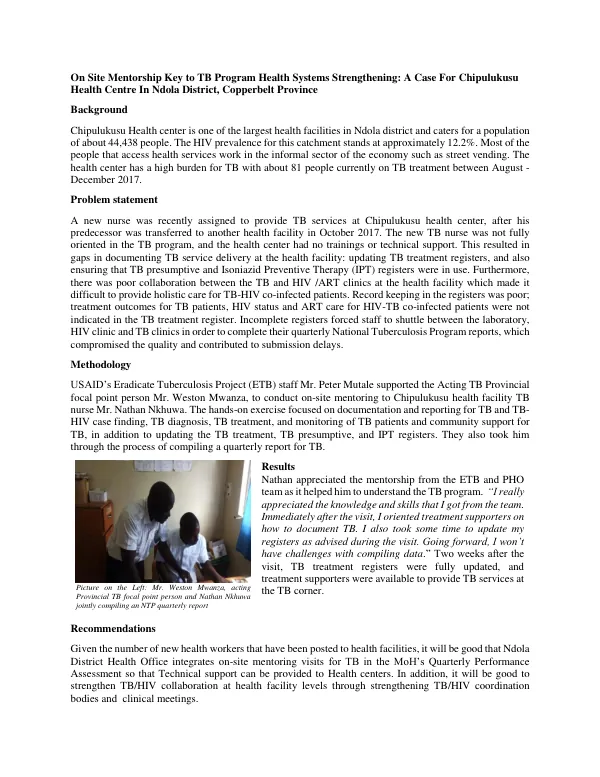
The health center has a high burden of tuberculosis (TB), with 81 people currently on TB treatment between August and December 2017. The TB nurse at the health center was recently replaced, resulting in gaps in documenting TB service delivery, including updating TB treatment registers and ensuring the use of TB presumptive and Isoniazid Preventive Therapy (IPT) registers. The lack of orientation and technical support for the new TB nurse led to poor collaboration between the TB and HIV/ART clinics, making it difficult to provide holistic care for TB-HIV co-infected patients. Record keeping in the registers was inadequate, with treatment outcomes for TB patients, HIV status, and ART care for HIV-TB co-infected patients not indicated in the TB treatment register. This resulted in staff having to shuttle between the laboratory, HIV clinic, and TB clinics to complete quarterly National Tuberculosis Program reports, compromising the quality and contributing to submission delays. USAID's Eradicate Tuberculosis Project (ETB) staff, led by Mr. Peter Mutale, supported the Acting TB Provincial focal point person, Mr. Weston Mwanza, in conducting on-site mentoring to Chipulukusu health facility TB nurse, Mr. Nathan Nkhuwa. The hands-on exercise focused on documentation and reporting for TB and TB-HIV case finding, TB diagnosis, TB treatment, and monitoring of TB patients and community support for TB, as well as updating the TB treatment, TB presumptive, and IPT registers. The on-site mentoring visit was successful, with Nathan appreciating the knowledge and skills gained from the ETB and PHO team. Immediately after the visit, he oriented treatment supporters on how to document TB and updated his registers as advised. Two weeks after the visit, TB treatment registers were fully updated, and treatment supporters were available to provide TB services at the TB corner. The visit also highlighted the importance of on-site mentoring in strengthening TB programs and improving health systems. The experience at Chipulukusu Health Centre suggests that on-site mentoring is a critical component of TB program health systems strengthening. Given the number of new health workers posted to health facilities, integrating on-site mentoring visits for TB into the MoH's Quarterly Performance Assessment could provide technical support to health centers. Additionally, strengthening TB/HIV collaboration at health facility levels through strengthening TB/HIV coordination bodies and clinical meetings could improve the provision of holistic care for TB-HIV co-infected patients.
Related documents