ICF
Zambia and Luapula Province Are on the Cusp of a Promising Future
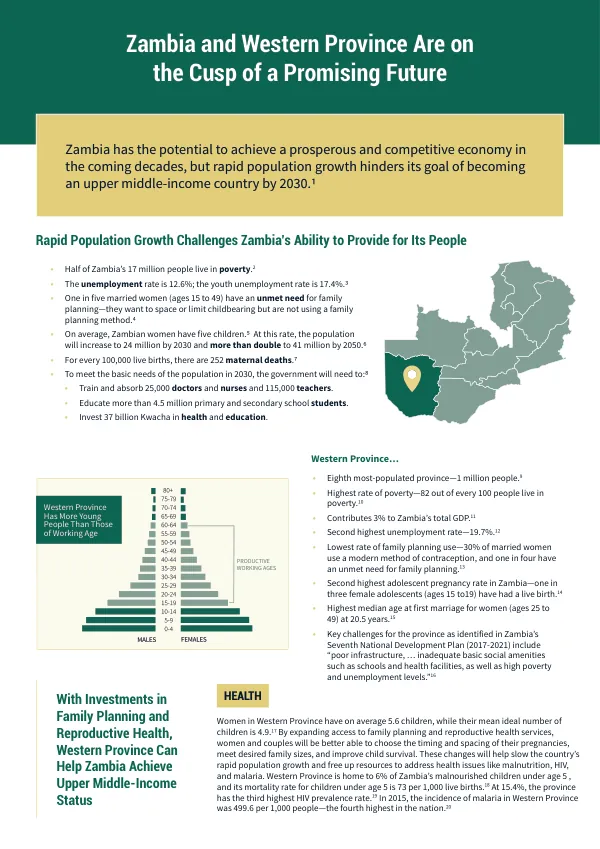
Zambia has the potential to achieve a prosperous and competitive economy in the coming decades, but rapid population growth hinders its goal of becoming an upper middle-income country by 2030.
2019 · 2 pages
Sign in to readA free account is required to download.
Abstract
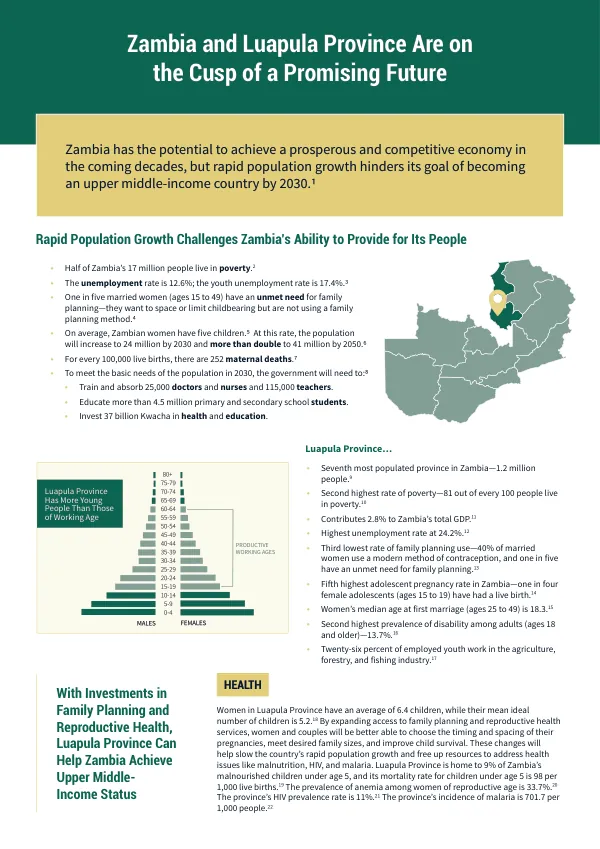
Half of Zambia's 17 million people live in poverty, with an unemployment rate of 12.6% and a youth unemployment rate of 17.4%. One in five married women have an unmet need for family planning, and the average woman has five children. At this rate, the population will increase to 24 million by 2030 and more than double to 41 million by 2050. Luapula Province, the seventh most populated province in Zambia, has a population of 1.2 million people and a poverty rate of 81%. The province contributes 2.8% to Zambia's total GDP and has the highest unemployment rate at 24.2%. Women in Luapula Province have an average of 6.4 children, while their mean ideal number of children is 5.2. Expanding access to family planning and reproductive health services can help slow the country's rapid population growth and free up resources to address health issues like malnutrition, HIV, and malaria. Luapula Province has more young people than those of working age, with 51% of the population dependent on the working-age population. Supportive policies like expanded access to family planning and reproductive health services can help increase Zambia's working-age population relative to its dependent population. This can create a more competitive workforce, decrease youth unemployment and poverty, and address rapid population growth. The province's HIV prevalence rate is 11%, and its incidence of malaria is 701.7 per 1,000 people. In 2017, Luapula Province had over 323,000 students enrolled in primary and secondary school, with 7,000 students receiving bursaries from the Ministry of General Education. Only 23% of adolescent girls in the province completed secondary school, compared to the national average of 30%. Almost half of the girls who experienced pregnancy in primary and secondary school that year did not return to school after giving birth. Eliminating barriers to family planning for youth will enable them to avoid pregnancy and stay in school. To achieve sustainable population growth and meet national development goals, Luapula Province must use demographic data to inform development policies and programs, and invest in multisectoral approaches that integrate population issues, including age-structure dynamics. The province must also increase prioritization and funding for and access to voluntary family planning and reproductive health services, with a focus on reducing unmet need and expanding access and services for young people. Improving educational outcomes by reducing adolescent pregnancy and ensuring that young mothers are able to stay in school is also crucial. Finally, investing in economic growth by creating youth employment and skills-building opportunities is essential for the province's economic success.
Related documents