UNIVERSITY RESEARCH CORPORATION CO., LLC
USAID TB CARE II Project, FY2016 Core Quarterly Report, January – March 2016
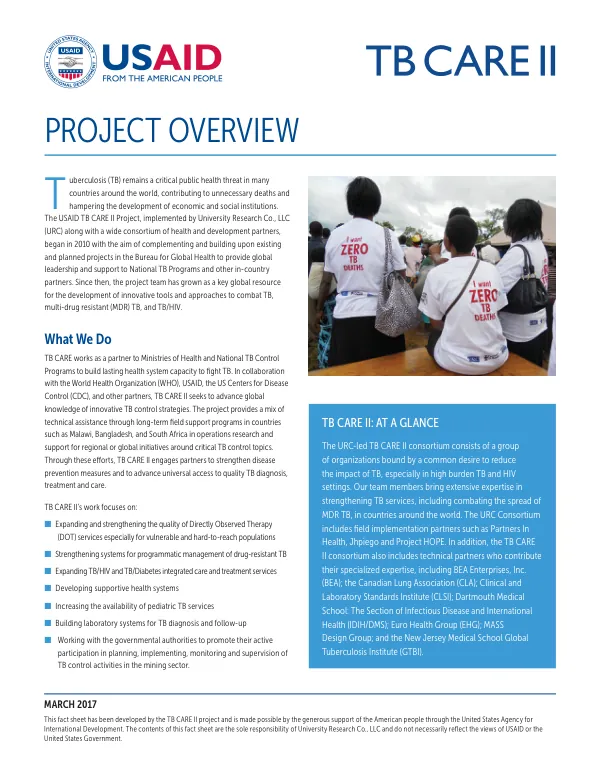
The TB CARE II Project is a USAID-funded initiative aimed at improving tuberculosis (TB) control and prevention in several countries in Africa.
2016 · 19 pages
Sign in to readA free account is required to download.
Abstract
The project's core quarterly report for January to March 2016 highlights progress made in implementing project activities during this period. Universal and early access to TB care is a key focus area for the project. In Swaziland, the project is conducting a prospective cohort study to assess patient adherence to Isoniazid Preventive Therapy (IPT) and determine patient outcomes. The study aims to identify critical periods for future interventions and investigate existing data collection practices in TB and ART clinics. Preliminary results show that IPT uptake was very high, approaching 100%, compared to less than 10% prior to the start of the study. However, patients complained of increased pill burden and frequency of refill pick-up due to isoniazid shortages. In Vietnam, the project assisted in introducing the FAST strategy to strengthen patient screening and triaging, as well as patient tracking and management. The FAST strategy focuses on early detection and treatment of TB and MDR-TB cases to reduce disease transmission among healthcare workers and patients. Implementation of FAST activities continued as planned in two provincial hospitals in Vietnam, resulting in the detection of 353 drug-sensitive TB and 20 MDR-TB cases. TB and silicosis in mines is another key area of focus for the project. The project is targeting mining companies and respective governments in Lesotho, South Africa, Zimbabwe, and Swaziland to improve detection and management of TB and other co-morbidities among mine workers and their families. A TB and silicosis training guide outline was developed, and terms of reference were developed to engage a consultant to develop a training package on TB and silicosis. Under the Public-Private Partnership platform, the project supported TB screening activities in various peri-mining communities in South Africa. Health systems strengthening is also a key component of the project. In Year 6, the project plans to integrate Palliative Care into Ethics of Tuberculosis Prevention, Care and Control Training Curriculum in consultation with the World Health Organization (WHO). Partner GTBI began planning two workshops on ethics, human rights, and tuberculosis in conjunction with key experts at WHO and URC. The project's progress in implementing project activities during the second quarter of FY16 is summarized below. Key activities and results achieved during this quarter include: * Completion of patient enrollment to IPT in all five facilities selected for implementation of the study in Swaziland, with excellent acceptance of IPT by eligible patients. * Commencement of data analysis and report writing for the IPT study, with preliminary results showing high IPT uptake. * Introduction of the FAST strategy in Vietnam, resulting in the detection of 353 drug-sensitive TB and 20 MDR-TB cases. * Development of a TB and silicosis training guide outline and terms of reference for a consultant to develop a training package on TB and silicosis. * Support for TB screening activities in various peri-mining communities in South Africa under the Public-Private Partnership platform. Overall, the TB CARE II Project made progress in implementing project activities during the second quarter of FY16, with a focus on universal and early access to TB care, TB and silicosis in mines, and health systems strengthening.
Related documents